Advanced Roth Conversion Strategies – For Taxpayers with IRAs worth $3M or more
A few weeks ago, I was playing pickleball with an older friend (in his early 70s) who told me he had $5M in his IRA and was contemplating converting the entire thing to a Roth IRA.
He asked me for my opinion, and I told him it was too complicated to discuss over pickleball! 😊
So, here is my somewhat detailed explanation of why at that level of wealth, a large Roth conversion may or may not make sense.
Before we dive in, let’s start with some basic schools of thought on when a Roth conversion does make sense:
Roth conversions make sense when you will save on taxes in the long term, because 1) your personal tax rate or 2) tax rates in general will go up in the future.
The first one (your personal tax rate) is knowable: I am having a low income year now, but my income is predictable and will be higher in the future.
The second one (general tax rates) is not and is based on pure speculation: $40T in national debt, greater levels of wealth inequality, proposals for wealth taxes becoming more mainstream, etc.
Roth conversions make sense when you will you avoid some lesser known taxes like NIIT, or expenses like IRMAA.
Basically, the idea is that a Roth conversion requires you to pay taxes on your money only once (at the time of the conversion). On the other hand, traditional IRAs have what are called Required Minimum Distributions (RMDs), which cause you to pay taxes annually on IRA withdrawals. More on RMDs later…
If that additional RMD income pushes you into a higher tax bracket, that can trigger additional taxes (NIIT) and additional Medicare Expenses (IRMAA).
Roth conversions make sense when your family/heirs will be better off inheriting Roth assets compared to a pre-tax IRA.
This one requires the least amount of explanation. In the case of my pickleball friend, he said he’d rather pay the taxes now and leave his kids $5M tax-free, rather than leaving them a fully taxable IRA.
Given that, if I were to sit down with my friend and analyze his situation, here is what I’d be looking for:
Tax Timing
Roth conversions should generally be done late in the year, after you’ve done a mock tax projection. I say that because I’d hate to have someone do a big conversion based on the assumption that they are having a low income year, only to have some external event occur that invalidates that assumption. Remember that Roth conversions are permanent and can no longer be recharacterized.
Market Timing
Market disruptions are potentially a great time to do a Roth conversion (March 2020, for example). While this goes against the previous bullet point, as they say, “Sometimes the situation is the boss.”
Imagine its March of 2020 and your $3M IRA has fallen to $2M. While some are panicking, you are converting the full $2M to a Roth IRA. Fast forward to today and your Roth IRA is now worth over $6M!
Paying the Bill
In my opinion, Roth conversions only make sense if you have the cash, outside of the IRA itself, to pay the tax bill.
Before we move on, let’s spend a minute on why someone may want to do a large Roth Conversion before they begin taking Required Minimum Distributions (RMDs).
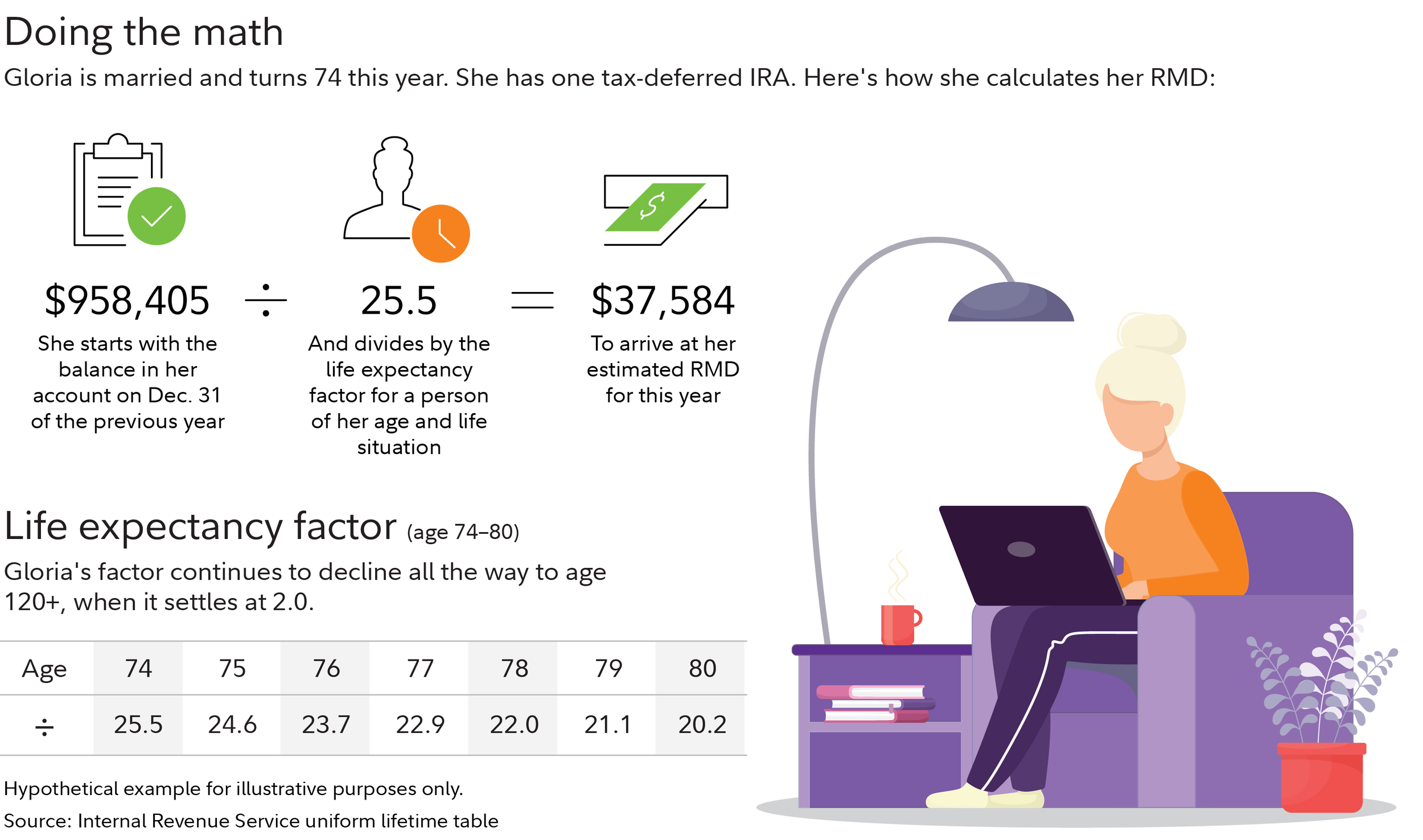
For those that are unaware, RMDs are where the IRS basically says: “You received a tax deduction for saving that retirement money, and you’ve received tax deferral along the way as your money has grown. Now you are at ‘retirement age’ and need to start taking withdrawals from your retirement accounts, whether you need the money or not.” Simply put, RMDs allow the IRS to tax that money as ordinary income.
See the image below for an example on an annual RMD calculation for Gloria, a fictitious 74 year old.
Source: https://www.fidelity.com/learning-center/personal-finance/retirement/required-minimum-distributions
This additional level of forced income does two things:
1) May subject you to the Net Investment Income Tax (NIIT).
Taxpayers may be subject to NIIT because of large IRA withdrawals that push their income above certain thresholds.
Here's how it works:
IRA withdrawals themselves are not subject to NIIT. The Net Investment Income Tax (a 3.8% tax under IRC §1411) applies only to net investment income — things like interest, dividends, capital gains, rental and royalty income, and passive business income.
Distributions from traditional IRAs [and other qualified retirement plans like 401(k)s] are specifically excluded from the definition of net investment income. So, the withdrawal amount itself never gets hit by the 3.8% NIIT.
However, it does count toward the income threshold. NIIT only applies once a taxpayer's Modified Adjusted Gross Income (MAGI) exceeds:
$200,000 for single filers
$250,000 for married filing jointly
$125,000 for married filing separately
(These thresholds aren't indexed for inflation, so they've stayed fixed since NIIT was introduced.)
That being said, IRA withdrawals are fully included in MAGI. So, a large IRA distribution (potentially from a Required Minimum Distribution or a big Roth conversion) can push your total MAGI over the threshold even though the withdrawal itself isn't investment income.
The practical effect: once you're over the threshold, NIIT kicks in on your other investment income (dividends, interest, capital gains, etc.) that otherwise might have escaped the tax, or on a larger slice of it. So the IRA withdrawal doesn't get taxed by NIIT, but it can cause your dividends, interest, or capital gains that year to become taxable under NIIT (or increase the amount subject to it).
A simplified way to think about it: NIIT is the lesser of (1) your net investment income, or (2) the amount your MAGI exceeds the threshold. A large IRA withdrawal grows that second number, which can make more of your investment income taxable.
One planning wrinkle worth knowing: Roth conversions have the same effect (they inflate MAGI), but qualified Roth withdrawals later in retirement do not, since qualified distributions aren't included in gross income at all.
2) May subject you to higher Medicare premiums, aka IRMAA.
Large IRA withdrawals, especially in retirement, can subject you to higher Medicare premiums, also known as IRMAA. The mechanism is similar in spirit to the NIIT situation.
Large IRA withdrawals inflate your MAGI, which is the trigger, even though the withdrawal itself isn't an "investment" or penalized in isolation.
How IRMAA works:
IRMAA (Income-Related Monthly Adjustment Amount) is a surcharge added to your Medicare Part B and Part D premiums if your MAGI exceeds certain thresholds. Unlike NIIT, IRMAA isn't a tax on specific types of income. It's based on your total MAGI, which includes:
Wages, interest, dividends, capital gains
Traditional IRA and 401(k) withdrawals (fully included)
Roth conversions (fully included in the year of conversion)
Social Security (the taxable portion)
Tax-exempt Muni bond interest (added back in for this calculation)
So, a large traditional IRA withdrawal (again, especially an RMD or a big Roth conversion) directly and fully raises the MAGI figure Medicare uses.
The key structural differences from NIIT that make IRMAA trickier:
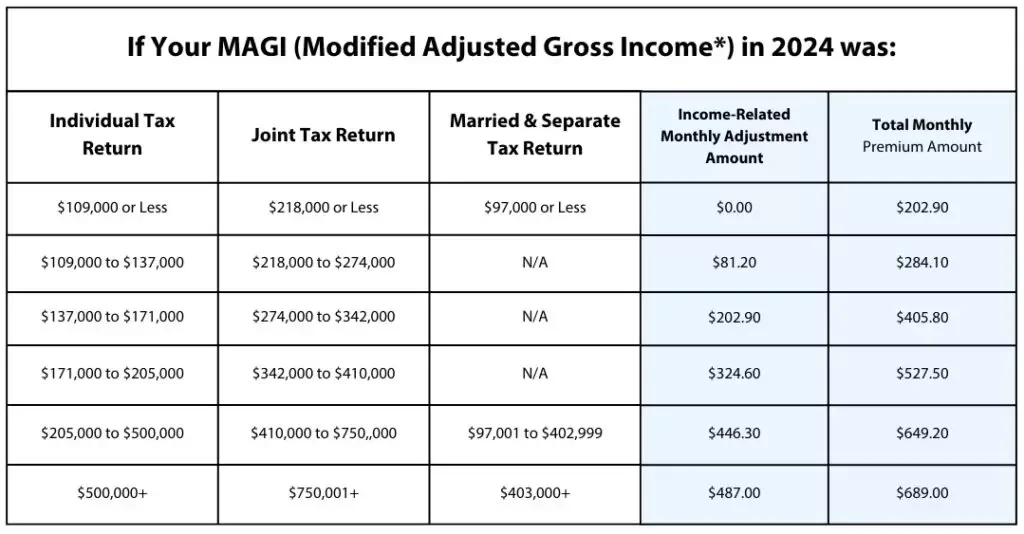
It's a cliff, not a phase-in. IRMAA uses income brackets (tiers), and crossing into the next tier by even $1 can trigger the full higher surcharge for that tier. There's no gradual phase-in like there sort of is with NIIT. This makes it much more punishing for someone who slightly overshoots a bracket.
It's a two-year lookback. Your 2026 Medicare premiums are based on your MAGI from your 2024 tax return. This is a common trap, because people don't realize a large withdrawal or Roth conversion this year will hit their premiums two years from now, often after they've already restructured their income and assume they're "safe."
It applies per person. For married couples, IRMAA is assessed individually on each spouse's Medicare premium, but based on the household's joint MAGI (if filing jointly). This means one spouse's large IRA withdrawal can raise both spouses' premiums.
It compounds with NIIT and other thresholds. A large IRA withdrawal in one year can simultaneously push someone into a higher IRMAA tier, trigger or increase NIIT liability, cause more of their Social Security to be taxable, and even affect eligibility for other income-tested benefits — all from the same dollar of MAGI.
Because IRMAA brackets are cliffs, the classic scenario is: a retiree takes a large one-time withdrawal (paying off a mortgage, a big purchase, a large Roth conversion) and doesn't realize it crossed an IRMAA threshold until two years later when premiums jump, sometimes by hundreds of dollars per month, per spouse.
Below is a chart on 2026 Medicare Part B IRMAA surcharges:
Source: https://medicaremall.com/irmaa-medicare-income-related-monthly-adjustment-amounts/
This is why many retirement/tax advisors talk about "IRMAA cliffs" specifically, and why some people do multi-year Roth conversion planning in smaller increments to stay just under a bracket line rather than doing one large conversion.
In our practice, before we do any Roth conversions, we run not only a mock tax projection for the current year, but also for the next 10 years. This way we can look at RMDs, NIIT, IRMAA, etc.
And this means sometimes a taxpayer is better off increasing this year’s tax bill in order to reap a lower tax bill in the future. This is the opposite of the standard, “Deduct as much as you can right now,” tax advice.
We recently took on a new client who hired a “tax specialist” that showed them several ways to lower this year’s tax bill, without any explanation of what effect it would have 2+ years from now. They were thrilled in year 1, confused in year 2, and upset by the time they found us and asked for real tax planning in year 3.
Summing Things Up
Before you start the process of converting a large IRA to a Roth, I would highly recommend sitting down with a Wealth Advisor who understands investments, tax planning, and estate planning because you need to factor in all 3 when making these decisions.
If you or someone you love is seeking this kind of advice around wealth and complexity, please send me an email at rob@swrpteam.com
Finally, our specialty is helping successful families navigate wealth and all the complexity that comes with it. We want to continue to write about the topics that are most important and interesting to readers like you – so if you have questions or blog article ideas, please reach out to us and let us know.
This material is purely intended to be general and educational in nature, and should not be construed as specifically-tailored investment, financial planning, tax, legal, or other professional advice. Information and data contained herein is as-of the date of publication, and may be subject to change in the future without notice. Any investment performance referenced is purely past performance, which is no guarantee of any future performance. Nothing contained herein should be construed as an offer to sell, a solicitation of an offer to buy, or a recommendation of any security or other financial product or investment strategy. All investment, tax, and financial planning strategies involve risk that you should be prepared to bear. You are highly encouraged to consult with professionals of your choosing before taking any action based on this material.