

Beyond “Buy Index Funds and Chill:” My Approach to an Aggressive Growth Portfolio
Equity Index Funds are good for 90% of people in the wealth accumulation phase. But, the other 10% of investors who are willing to accept more complexity in pursuit of a potentially better long-term outcome, may want to consider something else.
Today, I’ll do a deep dive into my optimal long-term portfolio that is more than the Bogle approach of “Buy index funds and chill,” or as the Reddit subreddit r/VTandchill often says, “VT & Chill.”

Why Index Funds Work For Most Accumulators
At the most basic level, an index fund is an ETF or mutual fund designed to track a specific market index. Common examples include:
VOO — Vanguard S&P 500 ETF
VTI — Vanguard Total Stock Market ETF
VXUS — Vanguard Total International Stock ETF
Index funds are considered “passive” because the manager’s objective is to track the index as closely as possible, not to make active security-selection decisions in an attempt to outperform it.
There are several compelling reasons why index funds can be all an investor needs:
They are extremely low cost and essentially “free” from a management fee perspective. (I will always put “free” in quotations because nothing is truly without cost. In this case, the cost comes in trading fees due to forced rebalancing when index funds change).
They are extremely tax efficient.
You never underperform the “market” and you remove the ability to flip flop between underperforming active funds, eliminating manager selection risk.
A portfolio of market cap weighted index funds is the collective wisdom of all investors, and thus an index fund investor benefits greatly from the free rider problem. Active managers spend a great deal of time, effort and capital to arrive at what they perceive as a fair price for a stock. Passive investors get the collective effort of all the research without the cost.
The market’s expected return has historically been enough for most investors to meet their financial goals.
For these reasons, I view index funds as the core building block of a long-term portfolio.
Here is an example of a globally diversified, market-cap-weighted equity portfolio:
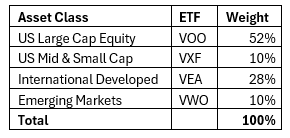
You can implement this with low cost ETFs through Vanguard, State Street, Charles Schwab, or whatever provider you desire. Moreover, you could simplify this entire portfolio by owning a single fund, The Vanguard Total World Stock ETF. I prefer breaking it into components because it makes the changes I make later easier to see.
…
From 1/1/1970 to 8/31/2026 (almost 57 years of returns), global equities have compounded at 10.07% (Source A). This means $10k invested on 1/1/1970 would be just under $2.3M dollars, which is utterly amazing.
If this is good enough for you – which I think should be for 90% of people, feel free to stop reading here and implement the portfolio yourself by allocating all your capital to VT.
If you want more…
If you could have compounded at 11% (93 basis point higher), how much more would you expect to have?
At 11%, you would have ended up with $3.8M, another $1.5M dollars! At 12%, you would have ended up with $6.4M and over double the index fund.
With compound interest, a small edge creates a massive gap over time.
And this is ultimately why many investors (including me) will never be satisfied with just the “market” return.
So, what is the best way to seek out that extra 1-2% a year?
Based on all my research and studies, I have found two broad methods for how I think this can be done: adding uncorrelated return streams with leverage, or tilting to value stocks.
1) Adding Alts with Leverage
If you use a portfolio optimizer, the optimal portfolio from a risk reward perspective is always a combo of stocks, gold, trend following, and bonds.
The issue with adding gold, trend, or bonds into an all equity portfolio is that these other assets have a lower expected return. This means in the journey to a more optimal portfolio, you find yourself sacrificing return. For a long-term portfolio, maiming the Sharpe ratio (risk to return score) doesn’t really do anything as all that matters is what return you got.
Now is where you may be asking, “Is there was a way to add in these other assets without selling equities?” And this is where leverage comes into play.
I know the word leverage is a scary word for investors, but when used within reason it is an incredibly powerful tool.
Most people employ leverage at some point in their life, and the best example of it is a mortgage on a home. When you buy a home (the asset) and put 20% down, that is the same as being 5x levered. For every $1 of your own money, you control an asset worth $5.
Quick example on a $500,000 home:
Down payment (your equity): $100,000
Mortgage: $400,000
If the home appreciates 10%, it's now worth $550,000. Your equity is $150,000, a 50% gain on your initial $100,000.
The same math cuts the other way if the home drops in value.
That leverage is a big part of why real estate can build wealth quickly, but also why being underwater is a real risk if prices fall.
In a similar fashion, leverage is the key to adding alternatives to a portfolio without selling equities. Institutions have been doing this since the 80s, and we’ve recently seen a resurgence of it coined as Return Stacking®, or portable alpha. The math of adding an alt through leverage rather than substitution makes the benchmark no longer equities, but just the cost of implementation. That cost is the risk free rate + a spread (the spread ranges over time and can be as low as zero for liquid futures such as treasuries or gold).
There are a lot of “other assets” that can be added on top of the global equity portfolio (VT), and this is my framework for considering them as a “Stack.”
1) Are they uncorrelated?
2) Will they earn a rate of return above their cost to implement?
A few that currently pass those tests for me are gold, trend following, multi-asset carry, and Bitcoin.
Two that don’t are bonds and equities. Bonds may be uncorrelated at times, but the 3mo to 10yr spread is still too tight for me to expect returns above the cost of implementation. Equities have a positive expected return above the cost to add, but this adds much larger expected portfolio drawdowns. And maybe you are different, but a 58% drawdown (2007-2008 GFC) is steep enough for me.
Of the assets that pass, there are a handful of ways you can implement this:
You can use futures.
You could use 2x or 3x daily levered Large US ETFs and buy alternatives ETFs for each strategy.
You can use Return stacked ETFs.
Of the three options, I think option 3 is the best because it is reasonably cost effective, allows extreme customization, and requires the least amount of work.
How I Implement Return Stacking
Return-stacked® ETFs generally provide approximately $1 of exposure to an alternative strategy on top of $1 of equity-index exposure. The current lineup includes combinations like U.S. large-cap equities plus trend following, carry, gold, Bitcoin, or gold alone. There are also international-equity-plus-trend options.
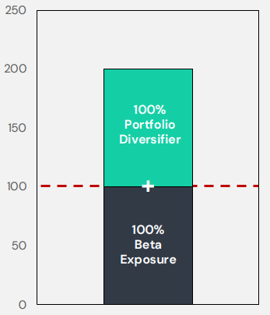
In practice, that allows me to replace a portion of traditional VOO and VEA exposure with funds that preserve equity exposure while layering in an alternative strategy.
Given the currently available options—and the value allocations I discuss later—I allocate 70% of the portfolio to return-stacked exposures.
To determine the mix of alternatives, I ran portfolio optimizations across several time periods. The average output suggested approximately a 2:1 allocation to managed futures strategies—trend and carry—relative to gold. Because Bitcoin has a limited history, I place it within the gold allocation bucket for this exercise.
That produced the following approximate targets:
1) 45% in trend following and carry
2) 25% in gold and Bitcoin
The CTA Index is roughly 80% trend following and 20% carry, which led me to use:
35% trend-following exposure
10% carry exposure
20% gold exposure
5% Bitcoin exposure
I capped Bitcoin at 5% of the portfolio rather than using a pure risk-parity allocation, which left the remaining 20% of that sleeve in gold.
Here is how that implementation looks.
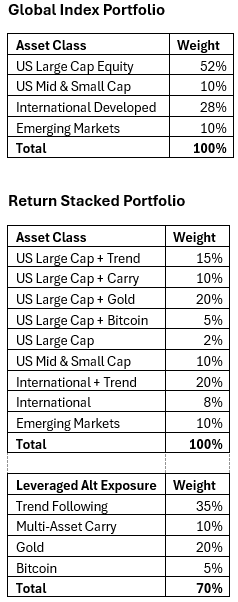
Based upon historical back tests, adding the alternative exposures could add roughly 2-3% annually (Source B), net of fund fees and estimated implementation costs. Using the lower end of the spectrum (2%) and applied to 70% of the portfolio, that equates to approximately a 1.4% increase in expected portfolio return.
That would move the portfolio’s expected return from approximately 10.07% to 11.47%.
But, just levering up an all equity portfolio could have the same effect for expected return. The reason I favor stacking alternatives is that doing so actually lowers expected max drawdowns.
Sound too good to be true? The tradeoff comes in the form of tracking error and will likely hurt most when stocks are ripping, and alternatives are going sideways or down (which is a real possibility and currently seen in many return stacked® ETFs right now).
Now for the second lever to pull:
2) Tilting to Value Stocks
Nike stock has been in the news a lot recently, as it’s in a 75%+ drawdown. Every person online is trying to give their take for what went wrong, though Meb Faber is the only person who I think has it right.
Paraphrasing a tweet of his: Nike used to trade at a 20PE, shot up to a 70PE, and now again trades at a 20 PE. A sportswear company with lots of competition and no moat should never have traded at a 70 PE, and this drawdown is just bringing it to be fairly valued at a market multiple.
This story emphasizes that no matter how great a company is, the price you pay is ultimately what matters in creating a good return. That is the essence of value investing: buying cheap, overlooked, and even “boring” companies at reasonable prices.
Value investing calls to me for two reasons.
It has a documented risk premium of over a market index.
I love getting a deal in life, so this is a strategy I can hold even when it’s not working.
Value investing has been termed “dead” in the US for many years, but when we go across the Atlantic or Pacific, it has been incredibly helpful. Thus, when I tilt to value, I want to do so across all areas of the market. The internal struggle I had was how much to tilt to value vs. add alts via leverage.
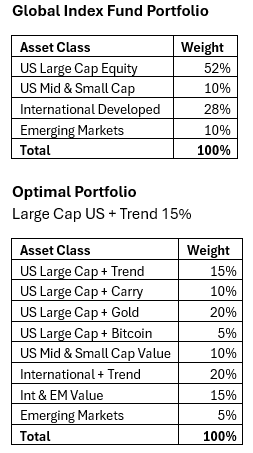
I decided on having 25% of my portfolio in various value ETFs across the globe. I think this gives a good balance while still having plenty of the value factor exposure. Unlike Return Stacked® ETFs, there are countless ways you can implement value. I decided on splitting it across 5 ETFs across Cambria and Avantis’ fund lineup. Here are the 5.
AVUV – Avantis US Small Cap Value: the Honda Civic of value investing. A low-cost, reliable, value ETF with strong factor exposure.
AVDV – Avantis International Small Cap Value: same as AVUV, just for international stocks.
SYLD – Cambria Shareholder Yield ETF: I love this fund’s implementation of value, as its core screener is looking for companies who are buying back their stock. CEOs have an incredible track record of buying back their stock when it’s cheap, and this is the best ETF to get exposure to buybacks without falling into a value trap.
EYLD – Cambria Shareholder Yield ETF: Same as SYLD, but for emerging markets. I am also a big fan of the Meb Faber Podcast, and this is a way I support him.
GVAL – Cambria Global Value ETF: This buys stocks in the 10 cheapest countries in the world by CAPE, and is the best pure deep value fund I have found.
This selection gives me a diversified approach to the value factor, which I think will have a 1% premium over index funds going forward. Research shows it from 2-3% (Source C), but I like to temper my expectations. At 25% of the portfolio, this added 0.25% increase in expected return to get to 11.72% total (11.47% + 0.25%), vs. market cap portfolio of 10.07%.
Here is a comparison of the index fund portfolio vs my “optimal portfolio” now with the value tilt added in.
Topics for Another Blog
There are several very important parts of managing a portfolio that I did not cover in today’s blog (rebalancing, taxes, dividend re-investment, position replacement), but that will have to wait for another day. Today, I want the focus to be on the “what,” and I will cover the “how” in its own blog.
In summary, this is my answer to what the other 10% of investors should do: add alternatives through leverage and tilt to value stocks in an effort to compound 1-2% more a year, which will turn into a meaningful difference over decades.
For investors who want more than “index funds and chill,” this is the philosophy we use at Summit when building aggressive-growth portfolios.
If you are looking for a more thoughtful approach than owning a broad-market index fund, send me an email (nick@swrpteam.com) and let’s see whether we may be a good fit to work together.
Sources:
(a) Global equity returns: https://testfol.io/analysis?s=1Yn82sjIBrL
(b) Expected Returns from Alternatives: https://www.returnstacked.com/whats-the-optimal-stack/
(C) Value Premium: https://www.k-dense.ai/examples/session_20260711_204815_4536879f8107/writing_outputs/final/fama-french.pdf
This material is purely intended to be general and educational in nature, and should not be construed as specifically-tailored investment, financial planning, tax, legal, or other professional advice. Information and data contained herein is as-of the date of publication, and may be subject to change in the future without notice. Any investment performance referenced is purely past performance, which is no guarantee of any future performance. Nothing contained herein should be construed as an offer to sell, a solicitation of an offer to buy, or a recommendation of any security or other financial product or investment strategy. All investment, tax, and financial planning strategies involve risk that you should be prepared to bear. You are highly encouraged to consult with professionals of your choosing before taking any action based on this material.