Mini Case Study: CA SDI Tax
This week, we helped one of our business owner clients in Danville, CA, optimize his salary to better manage his payroll taxes and his CA SDI taxes.
Here’s what that looked like:
Most small business owners know that they are paying both sides of payroll taxes, since they are both the employer and the employee.
So, an S Corporation business owner paying himself a salary of $750,000 is paying thousands of dollars more in payroll taxes than a business owner paying himself a salary of $250,000 and taking the rest as profits to the business.
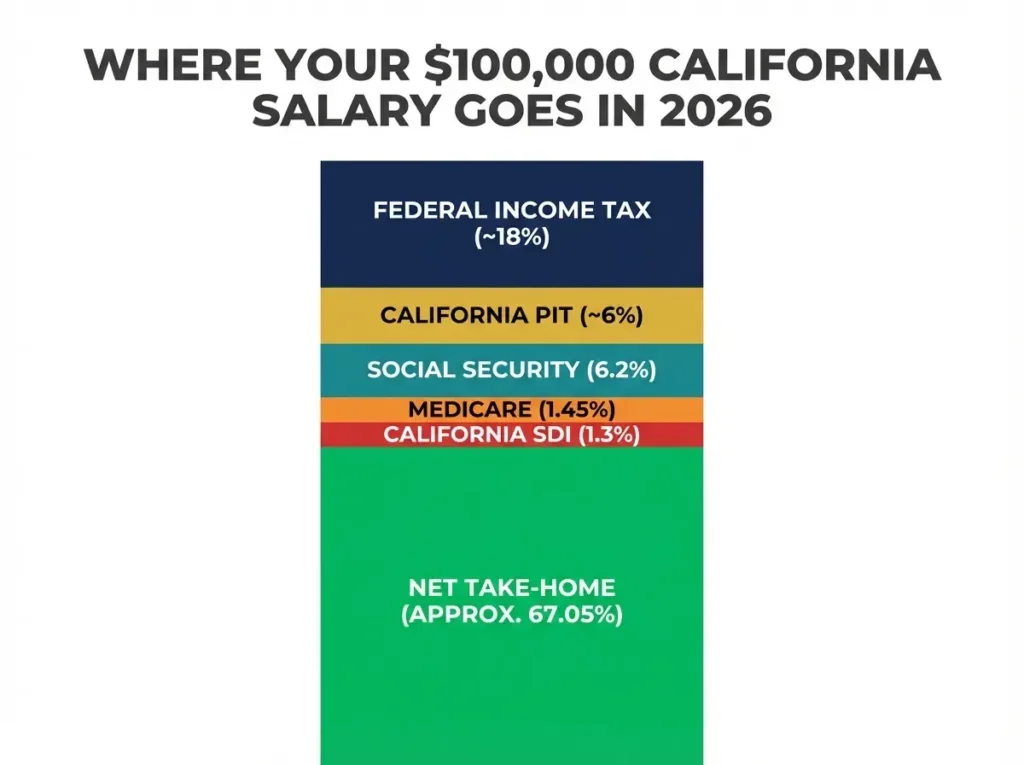
What most small business owners in California may not know is that in January 2024, California removed the wage cap on California SDI [a program that includes both Disability Insurance (DI) and Paid Family Leave (PFL)]. What this means is that in addition to payroll taxes [15.3% on the 1st $184,500 of wages and 2.9% above that, plus an additional Medicare surtax of .9% above $200,000 (single) or $250,000 (married filing jointly)], CA employees are also paying 1.3% on all wages in 2026. On a $750,000 income, that equates to $9,750 in additional taxes!
Admittedly, the calculation to determine one’s optimal salary is tricky because there may be a pre-tax retirement plan in place that uses your salary to help determine how much you can save for retirement, and there is also section 199A (the Qualified Business Income Deduction) to contend with, along with reasonable compensation requirements.
Our client and his partners have a very profitable business ($1,000,000+ net income is his share), and he has traditionally taken the vast majority of his profits as wages for the primary purpose of simplicity and tax withholding to satisfy safe harbor rules. Because of this, he was paying both self-employment taxes and the California SDI tax on the full amount of his wages.
Collaborating with his CPA, a system was developed. Rather than running the majority of his profits through payroll, he now takes a smaller salary following reasonable compensation guidance. This protects a larger chunk of his profits from payroll taxes and California SDI tax, saving thousands in taxes annually. And the best part, it did not affect his qualified business income deduction.
It is worth noting that the business owner now makes quarterly tax payments rather than all of his withholding being done through wages.
This is where a CPA and a CFP® professional can work together to figure out what’s optimal for you, potentially saving you thousands of dollars in unnecessary taxes.
Send me an email (dustin@swrpteam.com) or book a time on my calendar (https://calendly.com/dustin-swrp/60min) if you’re dealing with a similar situation and need a trusted Advisor that can help.
This material is purely intended to be general and educational in nature, and should not be construed as specifically-tailored investment, financial planning, tax, legal, or other professional advice. Information and data contained herein is as-of the date of publication, and may be subject to change in the future without notice. Any investment performance referenced is purely past performance, which is no guarantee of any future performance. Nothing contained herein should be construed as an offer to sell, a solicitation of an offer to buy, or a recommendation of any security or other financial product or investment strategy. All investment, tax, and financial planning strategies involve risk that you should be prepared to bear. You are highly encouraged to consult with professionals of your choosing before taking any action based on this material.