

Mini Case Study: Diversify Tax-Efficiently
This week I helped a family in Eagle, Idaho diversify away from a concentrated stock portfolio, with minimal taxes.
Here’s what that looked like.
One of our clients (we will call him Carl) was fortunate enough to identify the potential upside in a Boise company. So, he bought their stock early, before the A.I. chip boom started.
Fast forward to today and he’s sitting on a 7 figure unrealized capital gain.
This client is old enough to remember the dot.com bubble and how that ended, so his question to me was, “How do I take some risk off the table without getting killed in taxes?”
We took him through our 4-step Integrated Wealth & Tax process which is as follows:
Benchmarked his personal situation against our proprietary 50 Legal Ways to Reduce Your Tax Bill, and identified three strategies that work for him. We wrote a book on the 50 ways which you can download for free here.
Ran mock tax projections under three scenarios: 1) Sell and pay the taxes (as a base case); 2) Sell with 1 tax strategy; 3) Sell with all 3 tax strategies.
At this point, we had demonstrated the value of tax planning in real dollars, and projected what those dollars would grow to after being invested vs. sitting at the IRS.
He picked the options that suited his goals and we implemented the plan.
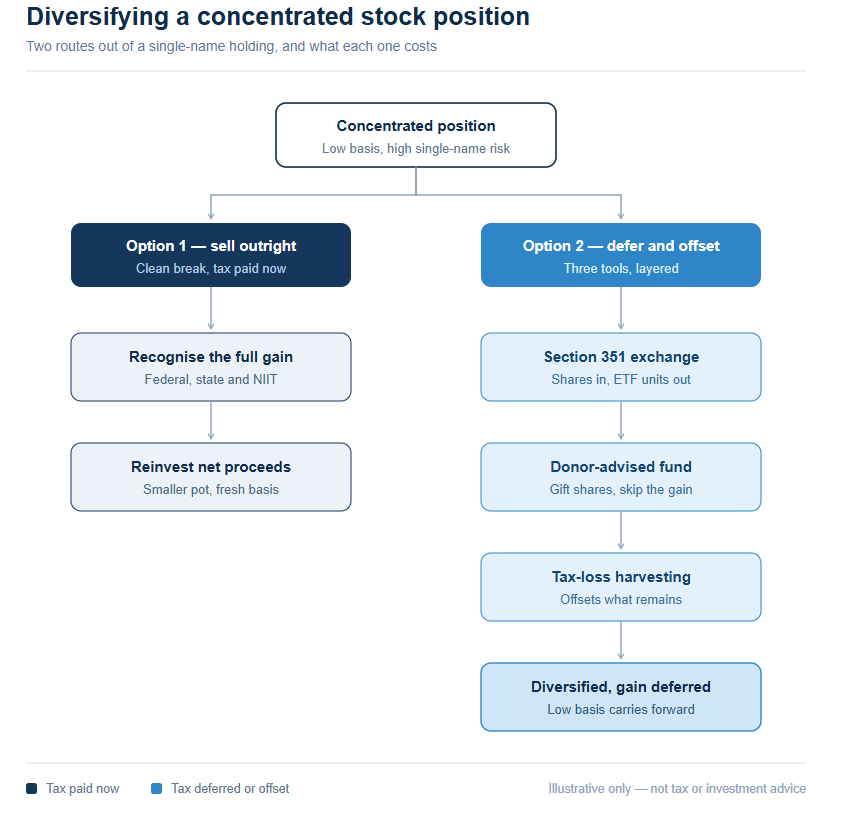
While every taxpayer is different, the typical strategies in this kind of situation include:
Section 351 Exchange: By following certain restrictions, this technique will allow him to swap the stock (along with other securities) in exchange for a diversified fund such as an S&P 500 index fund, without triggering an immediate tax bill.
Donor Advised Fund: Because our client likes to donate funds each year to his favorite local organizations (Boise State, Eagle High School), we can use some of his appreciated stock to fund these gifts without triggering a tax bill. This will also get him a large tax deduction this year that he can use immediately, even though these gifts will be doled out over many years.
Tax-Loss Harvesting: Finally, we showed the client how the aggressive use of tax-loss harvesting will help him offset the capital gains from the shares he does end up selling.
Combine this all together and we now have a client whose taken some significant chips off the table, set aside funds for the organizations he cares about, and diversified his portfolio all at the same time.
This material is purely intended to be general and educational in nature, and should not be construed as specifically-tailored investment, financial planning, tax, legal, or other professional advice. Information and data contained herein is as-of the date of publication, and may be subject to change in the future without notice. Any investment performance referenced is purely past performance, which is no guarantee of any future performance. Nothing contained herein should be construed as an offer to sell, a solicitation of an offer to buy, or a recommendation of any security or other financial product or investment strategy. All investment, tax, and financial planning strategies involve risk that you should be prepared to bear. You are highly encouraged to consult with professionals of your choosing before taking any action based on this material.