

Should Your Family Set Up a Multi-Generational Trust?
If I ask one of our ultra-wealthy families if they want to set up a “generation skipping” trust for their kids and grandchildren, I usually get a puzzled look followed by a response like, “I love my children, why would I want to skip them?”
However, if I ask this same question and instead say, “Do you want to set up a Multi-Generational Family Trust?” I get a completely different response.
And of course, if you are an estate planning attorney, you know that these two things are the same, just with slightly different names.
Welcome to the world of advanced estate planning.
Imagine your grandparents planted an apple orchard in their backyard. They're gone now, but every fall those trees still drop apples, enough for the whole family. A Multi-Generational Family Trust is kind of like that orchard. It's a way to put money aside so it keeps growing and sharing its "fruit" with your kids, grandkids, and even great-grandkids long after you're gone.
To understand how this big apple orchard works, you need to know four important roles:
The Giver (Grantor): This is the person who plants the apple tree. They put their own money and property inside the trust.
The Helper (Trustee): This is the manager. This can be a trusted friend, a family member, or a professional fiduciary. Their only job is to follow the rules of the trust. They are responsible for hiring professionals (CPA, attorney, wealth manager) to assist them in managing the trust.
The Receivers (Beneficiaries): These are the family members who get to enjoy the fruits of the tree. In a multi-generational trust, this includes your kids, grandkids, and future heirs.
Trust Protector: This is an independent third party appointed to oversee the trust, protect your beneficiaries, and modify the trust’s terms if laws change, without having to go to court.
As you can imagine, this kind of trust has its pros and cons. Let’s walk through them before diving into how the payouts work for future generations.
The Benefits:
🌳Your money keeps working, forever
When you put money into a trust, it doesn't just sit there. It gets invested, and those investments can pay out regular dividends (think of dividends like a paycheck the money earns, just by being there). Your family can receive these payments year after year, even generations from now.
🛡️It protects the money from bad situations
What if one of your kids gets in a lawsuit or goes through a messy divorce? A trust can shield the family money so it can't just be grabbed away. The money stays safe inside the trust, protected by its own set of rules that you wrote.
💰It can save your family a lot in taxes
When people pass away and leave money to their families, the government can take a big chunk of it in taxes. A trust is a smart, legal way to reduce how much the government takes, meaning more of your hard-earned money stays in the family.
📋You get to set the rules
You decide how the money gets used. Maybe you only want it used for education, or a first home, or only after someone turns 25. Some of our clients will tie dividends to earned income, so that for every dollar a beneficiary earns, they receive a dollar from the trust.
You're the one who writes the rulebook. Even after you're gone, your wishes get followed.
The Considerations:
💸It costs money to set up and keep running
Setting up this kind of sophisticated trust isn't inexpensive. In Boise, Idaho this will cost anywhere from $5,000 to $10,000, depending on what other estate documents you need and how complicated your personal balance sheet looks. In the Bay Area, assume it will cost at least twice that amount.
In addition, an irrevocable trust (which this will become either during your lifetime or after your death) has its own tax return, and that tax return will be a little bit more complicated than your typical 1040. So assume there will be an annual administrative cost as well.
🔒The money isn't always easy to get to
Because the money lives inside the trust with its own rules, family members can't pull it out whenever they want. While this may be a positive from the Grantor’s perspective, it is also a potential negative for the beneficiary trying to access the money.
🤝Family disagreements can get messy
Money and family are a tricky mix. When multiple people are supposed to share dividends from a trust, arguments can break out, especially if some family members feel the split isn't fair. This means a trust can sometimes create tension instead of harmony. This isn’t an issue when the source of funds is liquid, like a Charles Schwab brokerage account. But if the primary asset held in trust is a family-owned business or a piece of real estate, arguments over how much should be reinvested back into the business vs. how much should be distributed out to beneficiaries can occur.
📝The rules you write today might not fit tomorrow
A rule that made perfect sense 30 years ago might be outdated or even harmful today. This is where having a good Trust Protector comes into play. If you have an old Multi-Generational Family Trust that was written before Trust Protectors became more common, you may be stuck having to go to court every time you want to make a change to this trust.
How Do the Payouts Work?
Given all of that, my experience is that families with more than $10,000,000 in net worth are perfect candidates for this kind of multi-generational planning, especially in light of A.I. and what that might do to the job market in the future. While initially we had clients that were concerned this kind of planning would create future Paris Hiltons in their family, now clients are concerned that their grandchildren won’t have economic opportunities the way they once did.
You do not want your family to empty the apple tree orchard all at once. If they spend all the money today, there will be nothing left for the future grandkids. To prevent this, the trust uses a smart trick: it pays out dividends without touching the principal.
The orchard itself is the main pool of money, which experts call the principal. You do not cut down the trees to sell the wood. Instead, you take care of the trees, so they grow fresh apples every single year.
The apples are the extra money the orchard creates. This extra money comes from bank interest, stock market gains, or rent paid by people living in properties owned by the trust. The manager of the trust picks these apples and hands them out to the family members on a regular schedule. This might happen once a month or once a year.
Because the family only eats the apples, the trees stay perfectly safe. The main pile of money never gets smaller, allowing the trust to pay out rewards forever.
A Real-Life Example: The Jones Family
To see how this works in the real world, let us look at the fictional story of the Jones family.
Grandma Sarah Jones worked hard and saved $10 million. She wanted to make sure her family was safe forever, so she set up the Jones Family Trust.
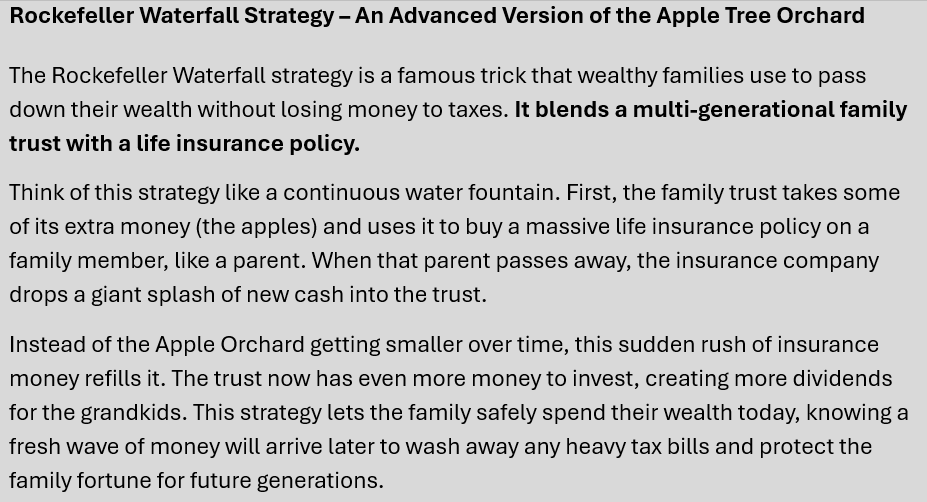
The Trustee invested the $10M into a diversified portfolio of stocks, bonds, commodities and real estate. The Trustee was also authorized to purchase life insurance policies on all of the beneficiaries of the trust, including Sarah.
Per Sarah's rules, the Trustee is authorized to distribute $500,000 per year, evenly between her two children, Tom and Emma. Tom and Emma each receive $250,000 every single year via quarterly distributions from the trust.
Here are 2 examples of how Sarah’s forward thinking helps keep the money in the trust for years to come:
Tom wants to buy a mansion, but he cannot because he does not own the $10 million. This rule saves him from wasting the family fortune. He lives comfortably on his yearly payout.
Emma’s marriage fails and her husband decides to divorce her. He tries to take her inheritance money, but the judge says "no." The money belongs to the trust, not Emma. Her future is perfectly safe.
When Tom and Emma grow old and pass away, the original $10 million is still completely intact. In fact, the wealth actually increased at their passing due to the life insurance proceeds on each of their lives. This is powerful because they each had 2 kids, so now the trust is providing income for 4 beneficiaries, so the extra funds are necessary.
Summing Things Up
Before you start the process of setting up a Multi-Generational Family Trust, I would highly recommend sitting down with a Wealth Advisor who understands investments, tax planning, and estate planning because you need to factor in all 3 when making these decisions.
If you or someone you love is seeking this kind of advice around wealth and complexity, please send me an email at rob@swrpteam.com.
Finally, our specialty is helping successful families navigate wealth and all the complexity that comes with it. We want to continue to write about the topics that are most important and interesting to readers like you – so if you have questions or blog article ideas, please reach out to us and let us know.
This material is purely intended to be general and educational in nature, and should not be construed as specifically-tailored investment, financial planning, tax, legal, or other professional advice. Information and data contained herein is as-of the date of publication, and may be subject to change in the future without notice. Any investment performance referenced is purely past performance, which is no guarantee of any future performance. Nothing contained herein should be construed as an offer to sell, a solicitation of an offer to buy, or a recommendation of any security or other financial product or investment strategy. All investment, tax, and financial planning strategies involve risk that you should be prepared to bear. You are highly encouraged to consult with professionals of your choosing before taking any action based on this material.