

Why We Passed on Private Credit & Private Equity
Last year, we decided against adding any private credit or private equity into our clients’ portfolios.
This past month, the largest private credit interval fund (CCLFX with $40 billion AUM) redeemed less than 1/3 of their withdrawal requests. Private equity managers are now taking loans against their own future carried interest. It’s safe to say the private space looks to be in trouble and not a place where permanent, irreplaceable capital should be allocated.
Here’s how we arrived at that decision.
Post the Global Financial Crisis, private credit funds have exponentially increased in assets as traditional bank lending standards became increasingly tight as a result of the Dodd-Frank Act.
As fiduciaries to our clients, we feel the obligation to explore any and all plausible investment opportunities.
After hearing Larry Swedroe, a titan of our industry and someone whose opinion we value, speak highly of owning private equity and private credit in a new format called the interval fund, we thought it was worth a look.
An interval fund is akin to a mutual fund, but it only has quarterly or semi-annual liquidity, as the underlying assets are not publicly traded. It is the ideal structure over an ETF or mutual fund to own something that does not trade in the public market.
We met with wholesalers from many teams like KKR and Cliffwater (who manages the largest private credit interval fund).
Private equity and private credit are intertwined, since private credit gives loans to private equity. So, to assess one, you must understand both.
The pitch of each of these is that you earn an illiquidity premium of 3%+ for holding illiquid assets, and that private companies can focus on long-term results rather than worrying about quarterly earnings calls.
After all the meetings and phone calls, there was one specific item we could not get past:
The underlying companies in private credit funds were borrowing at 12–14% (SOFR + ~500bps). Why would any company borrow at such rates, unless they are extremely risky businesses?
And that’s not just intuition, it’s the design of the asset class.
The majority of private credit loans are sub-investment grade, made to companies with lower credit ratings and less ability to access public debt markets. These are borrowers that couldn’t qualify for a bank loan or a publicly traded bond.
Many of the low-quality issuers once found in the high-yield bond market have migrated to private credit where they can borrow with more flexibility on terms, including fewer financial disclosure requirements. In other words, private credit is increasingly the lender of last resort for companies that public markets already said no to.
And private equity deserves its own scrutiny.
Much of our thinking on private equity was sharpened by the research of Dan Rasmussen, founder of Verdad Advisers, who worked at Bain Capital before spending years studying thousands of leveraged buyout deals.
His conclusion, which we find compelling, is that private equity is essentially leveraged micro-caps with lockups and high fees, and that investors have been lulled into underestimating the risk.
A few of his findings stuck with us:
The historical edge came from cheap entry prices, not magic. In the 1980s and 1990s, buyout firms bought businesses at 4–6x EBITDA. Those low entry multiples, not operational genius, drove the outsized returns. Today, deals routinely get done at far higher multiples, and Rasmussen’s research found that roughly half of deals done above 10x EBITDA returned nothing to investors, net of fees.
The credit quality is far worse than investors realize. By Rasmussen’s analysis, the vast majority of private-equity-backed companies carry credit quality of single-B or below, with a meaningful chunk rated CCC. Yet when he surveyed institutional investors, over 70% believed the average credit quality was BB or better. The people allocating billions had no idea how fragile the underlying businesses actually were.
“Smoothed returns and laundered volatility.” Because private assets aren’t marked to market, their reported volatility is artificially low. Rasmussen warns advisors not to let smoothed returns and laundered volatility trick you into thinking these aren’t high-risk investments. The risk didn’t disappear, it was hidden by infrequent and subjective valuations. Independent research backs this up: one PitchBook study estimated the true volatility of private equity at roughly 17%, versus the ~10% typically reported.
The uncomfortable takeaway is that private equity and private credit are two sides of the same trade.
Private credit supplies the leverage that lets private equity pay ever-higher purchase prices, which is exactly what enables the aggressive valuations and EBITDA adjustments in the first place. When you own both, you’re not diversifying; you’re doubling down on the same bet.
History may not repeat, but it does rhyme.
The Savings & Loan Crisis of the 1980s and early 1990s offers a sobering parallel. After deregulation loosened lending restrictions, S&Ls, previously confined to conservative mortgage lending, rushed into higher-yielding, riskier assets: commercial real estate, junk bonds, and speculative development projects.
The pitch was familiar: higher yields justified the risk. Deposit insurance provided a false sense of security. Regulators and investors alike assumed that diversification and yield spreads were sufficient buffers. They weren’t.
When the commercial real estate market turned and interest rates adjusted, the losses were catastrophic. Over 1,000 institutions failed, costing taxpayers an estimated $130 billion, and the Resolution Trust Corporation spent years unwinding the wreckage.
Sound familiar? Today, non-bank lenders, operating largely outside the regulatory perimeter that governs banks, have rushed into higher-yielding, riskier loans to companies that traditional lenders turned away. They raised trillions in capital during a zero-interest-rate environment, deployed it aggressively into leveraged borrowers, and packaged it into investment vehicles promising yield with the illusion of stability. Interval funds and non-traded BDCs gave retail investors access to assets that, by their very nature, cannot be liquidated on demand.
And just as S&L depositors discovered that “stable” didn’t mean “liquid,” private credit investors are now finding out the hard way that quarterly redemption windows don’t work when the underlying loans have a five-year maturity.
Time and time again, we fail to learn from our mistakes.
The S&L crisis. The dot-com bubble. The subprime mortgage crisis. In each case, the pattern was identical: a period of deregulation or regulatory arbitrage, an influx of capital chasing yield, loosening underwriting standards, opaque valuations, and ultimately a reckoning when the tide went out. Private credit today checks nearly every one of those boxes.
The lenders making the loans are the same ones valuing them, creating a clear incentive to delay recognizing borrower problems when they hope things might work out. The Financial Stability Board formally warned that valuation opacity and reliance on ratings from smaller, lesser-known agencies can amplify strains in stress scenarios.
Howard Marks of Oaktree put it plainly: when the tide goes out, some bare bottoms get exposed. Roughly $2 trillion in direct loans has been made in the last 15 years, up from $150 billion just two decades ago, with some managers likely accepting too much capital and deploying it too fast, applying standards that were too low.
The risk profile of these borrowers is increasingly coming into focus. Certain smaller private credit issuers have recently recorded default rates approaching 11%, concentrated in highly leveraged, rate-sensitive borrowers, particularly software companies facing AI disruption. Lenders have used “amend-and-pretend” tools such as maturity extensions and covenant waivers to keep borrowers afloat, delaying the recognition of true losses.
This isn’t transparency. It’s the same extend-and-pretend playbook S&Ls used in the late 1980s before the losses became undeniable.
And just like the S&L era, when stress hits, the promised diversification benefits vanish. During financial or economic shocks, private credit’s correlation to mainstream credit markets reverts to one, meaning you lose the diversification benefit precisely when you need it most. The primary concern becomes return of capital rather than return on capital.
On top of all of this, both private equity and private credit carry substantially higher fees than low-cost ETFs, often layering management fees, performance allocations, and fund expenses that can total 3–4% annually before an investor sees a single dollar of net return.
So where do we look instead for true diversification?
Our view is that genuine portfolio resilience comes from allocations that are structurally uncorrelated to equities and credit, assets that don’t just promise diversification in the brochure, but deliver it when markets are under stress.
That’s why we allocate to trend following (managed futures) and precious metals as our alternative positions.
Trend following does not rely on economic growth to generate returns. It has historically been uncorrelated to equities, bonds, real estate, and other asset classes. More importantly, it has tended to perform best precisely when other asset classes struggle, offering a genuine counterbalance when stocks are meaningfully down. Unlike private credit, which loses its diversification benefit when you need it most, trend following has historically earned its keep in the worst environments.
Gold serves a different but complementary role. Its long-term outlook is supported by central banks and investors seeking protection, diversification, and de-dollarization, with rising geopolitical risks, inflation concerns, a potentially weaker dollar, and the risk of meaningful corrections in stretched equity markets all providing structural tailwinds.
Neither of these strategies requires locking up capital for years, tolerating opaque valuations, lending to companies that couldn’t qualify for a bank loan, or paying 3–4% in annual fees. They are liquid, transparent, and have earned their place in our portfolios the old-fashioned way, by actually being uncorrelated when it matters.
Private capital markets may work well for institutional investors with decade-long time horizons, unlimited capital, and access to top-tier managers. For our clients, for whom capital is permanent and irreplaceable, we’d rather own assets that are honest about what they are.
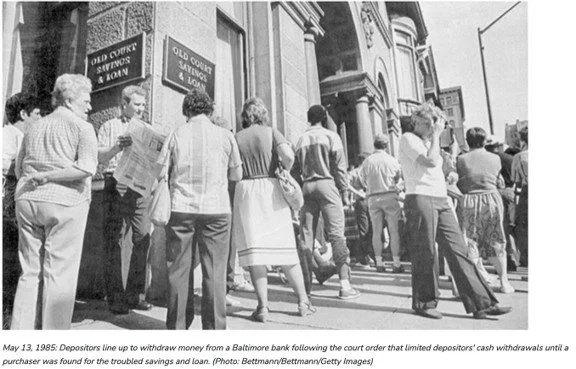
The S&L crisis didn’t end the financial system. Neither will this. But it did destroy a generation of institutions that ignored the warning signs. We intend to heed them.
This material is purely intended to be general and educational in nature, and should not be construed as specifically-tailored investment, financial planning, tax, legal, or other professional advice. Information and data contained herein is as-of the date of publication, and may be subject to change in the future without notice. Any investment performance referenced is purely past performance, which is no guarantee of any future performance. Nothing contained herein should be construed as an offer to sell, a solicitation of an offer to buy, or a recommendation of any security or other financial product or investment strategy. All investment, tax, and financial planning strategies involve risk that you should be prepared to bear. You are highly encouraged to consult with professionals of your choosing before taking any action based on this material.