Mini Case Study: How a Home Sale Helped Our Client Retire Three Years Early
This month, we helped a client in San Ramon, CA retire in 2026 instead of 2029. A home sale and cash purchase in the Bay Area cut his annual housing costs by $30,000 and brought his withdrawal rate down to a sustainable level.
If you’re in the Bay Area and have owned your home for over a decade, chances are you’re sitting on a large pile of home equity from price appreciation and mortgage paydown. You may also have refinanced into a historically low mortgage rate in 2020/2021. As retirement approaches, downsizing or lowering your annual expenses can become a priority. For our client (who we will call Bob), it was exactly that.
Bob was recently laid off, which left him at a crossroads: retire early, or go back to the workforce and stick to his original retirement timeline of 2029. After reviewing his annual expenditures, we saw that his biggest obstacle to retiring early was housing, as it was his largest expense at $50,000(+) per year. If we could greatly reduce it, early retirement would become possible.
That meant selling his home in San Francisco in a strong real estate market and buying a smaller home with cash in a surrounding area.
Sounds simple, but many variables go into it. Here is the planning involved:
Analyze the retirement income Bob could generate from his fixed sources (Social Security and a pension), plus what his portfolio could safely provide.
Compare his annual expenditures against that income to determine whether they could be met without a withdrawal rate higher than recommended.
Identify that his housing expenses of $50,000 per year were holding back early retirement. If we reduced them through a home sale and cash purchase, we could close the cash flow gap.
Run a preliminary sale analysis, including meetings with real estate professionals, to determine how much cash Bob would have for a cash purchase.
Home Sale Analysis
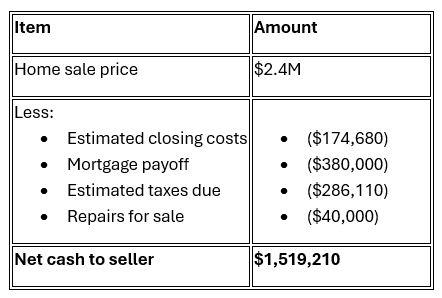
The tax estimate starts with Bob’s cost basis of $1,115,000. We subtracted that basis and the selling costs from the sale price to arrive at his gain, then applied the $250,000 home sale exclusion. Federal capital gains tax, the net investment income tax, and California income tax apply to the remainder.
The rest of the process:
Execute the sale and adjust the final figures if they differ materially from projections.
Identify a replacement home and complete the cash purchase. Bob bought a home for $1.2M and put $50k of improvements into it. That left about $269k to add to his liquid portfolio and further support withdrawals.
If applicable: Transfer his property tax base under Prop 19. California homeowners age 55 or older can carry their existing property tax base to a replacement home, but the purchase must happen within two years of the sale, and a claim must be filed.
Fold the new housing costs into his retirement cash flow. Bob’s fixed housing expenses dropped from $50,000 to about $20,000. With no mortgage, he is only responsible for property taxes and homeowners insurance. Repairs and upgrades are tracked separately.
The Result
Bob also began collecting Social Security, so we compared the old house and the new house with Social Security turned on in both. That isolates the effect of the home sale itself.
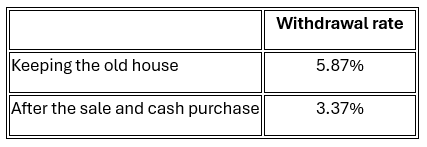
Without the move, Bob’s withdrawal rate would have stayed above what we consider sustainable for a long retirement. After it, the rate fell by 2.5 points, and he was able to retire in 2026, three years ahead of schedule.
A lot goes into a transaction like this, including estimating the tax bill on a residence sale, applying the home sale exclusion, and calculating closing costs and cost basis. That’s why it helps to have a wealth manager who understands your cash flow, balance sheet, and tax situation. Transactions this large should be calculated carefully.
Send me an email (dustin@swrpteam.com) or book a time on my calendar (https://calendly.com/dustin-swrp/discovery-phone-call) if you’re dealing with a similar situation and want a trusted advisor to help.
This reflects one client’s experience. Individual circumstances differ, and results will vary.
This material is purely intended to be general and educational in nature, and should not be construed as specifically-tailored investment, financial planning, tax, legal, or other professional advice. Information and data contained herein is as-of the date of publication, and may be subject to change in the future without notice. Any investment performance referenced is purely past performance, which is no guarantee of any future performance. Nothing contained herein should be construed as an offer to sell, a solicitation of an offer to buy, or a recommendation of any security or other financial product or investment strategy. All investment, tax, and financial planning strategies involve risk that you should be prepared to bear. You are highly encouraged to consult with professionals of your choosing before taking any action based on this material.