Revocable vs. Irrevocable Trust: What’s the Difference?
When considering a trust as part of an estate plan, one of the first questions that comes up is: What type of trust should I use?
Two of the most common categories are revocable trusts and irrevocable trusts. While both can be used to hold and manage assets for beneficiaries, they work very differently.
The biggest distinction comes down to control and flexibility.
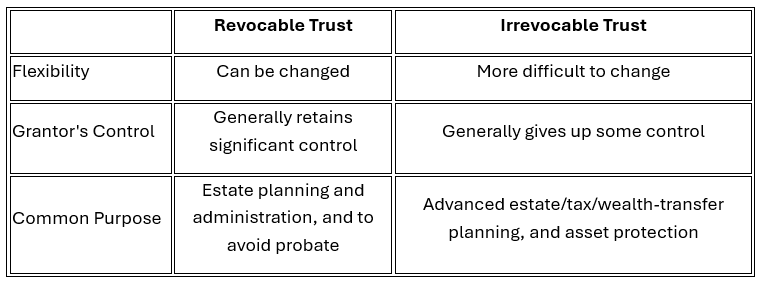
A revocable trust generally allows the person who creates it to retain significant control over the assets and make changes during their lifetime.
An irrevocable trust generally involves giving up some degree of control in exchange for potential estate planning, tax, and asset-protection benefits.
The appropriate structure depends on your goals, assets, family circumstances, and overall financial and estate plan.
What Is a Revocable Trust?
A revocable trust, sometimes called a revocable living trust, is a trust that can generally be changed, amended, or revoked by the person who created it.
The person who creates it is called the grantor or trustor. In many revocable trust arrangements, the grantor also serves as the trustee during their lifetime. This means they can continue managing the assets placed into the trust much as they did before creating it.
For example, imagine someone who creates a revocable trust and transfers their investment account into the trust. They may still be able to buy and sell investments, receive income from the account, and manage the assets according to the terms of the trust.
Flexibility
One of the primary advantages of a revocable trust is flexibility.
Because it can be amended or revoked, the grantor can make changes as circumstances change. Beneficiaries can be added or removed, trustees can be changed, and provisions can be updated as the individual's family or financial circumstances evolve.
Marriage, divorce, the birth of children or grandchildren, changes in financial circumstances, business ownership, relocation, or changes in family relationships can all create reasons to review an estate plan.
A revocable trust can evolve with the person who created it.
How Is a Revocable Trust Used in Estate Planning?
Revocable trusts are often used as part of an overall estate plan. One common goal is to provide instructions for how assets should be managed and distributed after the grantor's death.
For example, a parent may establish a revocable trust that states how their assets should be distributed among their children, with instructions for who will manage the assets and how the beneficiaries will receive them.
A revocable trust can also provide continuity if the grantor becomes incapacitated. The grantor may initially serve as trustee, but if they become unable to manage their financial affairs, a successor trustee named in the trust can step in and manage the trust assets according to the trust's terms.
This can provide a transition plan for managing financial assets without requiring the grantor to make decisions during a period when they may no longer be able to do so.
Revocable Trusts and Probate
Another reason revocable trusts are used is to avoid probate.
Probate is the court-supervised process that may be used to administer a person's estate after death. Depending on state law and the type of assets involved, probate can involve time, expense, and public filings.
When assets are properly titled in a revocable trust, they may be administered by the successor trustee according to the trust document rather than passing through the probate process.
What Are the Limitations of a Revocable Trust?
The flexibility of a revocable trust is also one of its limitations.
Because the grantor generally retains control over the trust assets, a revocable trust typically does not provide the same level of asset-protection or estate-tax benefits that may be available through certain irrevocable trust structures.
In many situations, the assets of a revocable trust are still considered part of the grantor's estate for estate tax purposes. Likewise, transferring an asset into a revocable trust generally does not mean that the grantor has placed the asset beyond the reach of creditors.
Revocable trusts are designed for control, management, and estate administration rather than to permanently remove assets from the grantor's ownership or estate.
What Is an Irrevocable Trust?
An irrevocable trust is more restrictive than a revocable trust.
Once an irrevocable trust is established and assets are transferred into it, the person who created the trust generally gives up some degree of control over them. The exact amount of control given up depends on the specific trust and how it is drafted.
Unlike a revocable trust, an irrevocable trust cannot be changed or revoked whenever the grantor wants. There may be circumstances under state law or the terms of the trust that allow modifications, but these require additional steps and may involve the trustee, beneficiaries, courts, or other parties.
This reduced flexibility is one of the most important considerations when establishing an irrevocable trust.
Why Would Someone Create an Irrevocable Trust?
While irrevocable trusts can be more complicated, they can also be useful for more advanced estate and tax planning.
Depending on the structure, an irrevocable trust can be designed to:
Transfer wealth to future generations
Manage estate tax exposure
Provide for beneficiaries while placing certain restrictions on distributions
Protect assets from creditors
Support charitable giving
Hold life insurance or other assets outside of the grantor's taxable estate
Implement other sophisticated wealth-transfer strategies
The specific benefits depend on the type of irrevocable trust and its terms.
Estate Tax Benefits
Irrevocable trusts are associated with advanced estate planning because of their impact on the taxable estate.
Depending on how an irrevocable trust is structured, assets transferred to it may no longer be considered part of the grantor's estate for federal estate tax purposes. This can be important for individuals and families whose estates may be subject to estate taxes.
But, placing an asset into an irrevocable trust does not automatically eliminate estate taxes. The tax treatment depends on the trust's specific provisions, the assets involved, how the transfer is made, and the rights retained by the grantor.
Because the rules can be complex, irrevocable trust planning should generally be completed with guidance from qualified legal and tax professionals.
Potential Asset-Protection Benefits
Irrevocable trusts may also be used as part of asset-protection planning.
The basic concept is that assets transferred to an irrevocable trust may no longer be owned directly by the person who created the trust. And because the grantor gave up certain rights and control, the assets may receive protection that would not be available if they remained in the grantor's individual name.
However, asset protection is highly dependent on the circumstances and the specific trust structure. Timing is also important. Transferring assets to a trust after a creditor claim or legal problem can create significant legal issues.
For that reason, asset-protection planning is generally something to consider before a problem occurs rather than after.
Revocable vs. Irrevocable
Revocable trusts provide more flexibility and control, while irrevocable trusts provide opportunities for more advanced planning in exchange for giving up some control.
Which Type of Trust Is Right for You?
For someone concerned with avoiding probate, maintaining control over their assets, planning for incapacity, and establishing a clear framework for distributing assets to beneficiaries, a revocable trust may be appropriate.
For someone with significant wealth, business interests, estate tax concerns, or specific asset-protection or wealth-transfer objectives, an irrevocable trust may be appropriate.
In some cases, an estate plan may incorporate both types of trusts or multiple specialized trusts.
Also, remember that a trust is only one piece of an overall estate plan. Other important components include a will, financial powers of attorney, healthcare directives, beneficiary designations, life insurance, and business ownership documents. All of these pieces should be coordinated so that the plan works as intended.
For example, someone may have a well-drafted trust but outdated beneficiary designations on their retirement accounts. Or they may create a trust but fail to properly transfer certain assets into it. Regular reviews can help identify these issues and ensure that the plan continues to reflect your current circumstances and objectives.
This material is purely intended to be general and educational in nature, and should not be construed as specifically-tailored investment, financial planning, tax, legal, or other professional advice. Information and data contained herein is as-of the date of publication, and may be subject to change in the future without notice. Any investment performance referenced is purely past performance, which is no guarantee of any future performance. Nothing contained herein should be construed as an offer to sell, a solicitation of an offer to buy, or a recommendation of any security or other financial product or investment strategy. All investment, tax, and financial planning strategies involve risk that you should be prepared to bear. You are highly encouraged to consult with professionals of your choosing before taking any action based on this material.