If It Were Easy, Everyone Would Do It: Creating and Sticking to a Financial Plan as a Sales Professional
Everyone could tell you how to have a 6 pack. Go to the gym 3-4 times a week, maintain a caloric deficit, and eat a high protein/low carb diet. Despite how “easy” it is, only 1-2% of men maintain a visible six pack year-round. For men over 35, that number drops to 0.004%, or about 1 in 25,000.

The same thing can be said about having a $1 million investment portfolio. Put away $1000 a month for 30 years, earn a 7% CAGR, and you will have $1.2M. Yet only 14% of households (or 1 in 7) age 65+ have an investment portfolio over $1M.
The hardest part about having a 6 pack and a $1M portfolio is the discipline required to stick to the plan. It’s even harder when you work in a sales role and have lumpy pay.
Below is the planning process I am using with clients I will call Anakin and Padmé. Their names have been changed, but their situation will feel familiar for many high-earning sales professionals. They want help converting a high household income into a lasting net worth.
Step 1: Establish the Goal
Anakin and Padmé are married and have a newborn son, Luke. Their goals are to:
Buy a home
Build long-term wealth
Retire securely
Give their son a strong financial foundation
Your goals may be different. What will be the same though, is that you need to define what you value, what you want your money to accomplish, and the actions required to get there.
Step 2: Build a Net Worth Statement
A net worth statement is like a scale during a fitness journey. It provides an honest starting point and allows you to measure progress over time.
At the beginning of the planning process:
Padmé has approximately $240,000 in her 401(k).
Anakin has approximately $80,000 in his various 401(k) accounts.
They have about $30,000 in their checking accounts.
They carry roughly $100,000 of debt, between student loans, credit-card debt, and an auto loan.
Their current net worth is approximately $250,000.
This is not a bad place to start. They have strong incomes, retirement assets, and an opportunity to improve their financial position quickly. But before investing aggressively or shopping for a home, they will need to eliminate high-cost debt and create a more durable cash-flow system.
Step 3: Build the Baseline Cash Flow
Cash flow is the engine of every financial plan. It determines how much flexibility you have, how quickly you can reduce debt, and how much you can invest toward long-term goals.
For clients in the accumulation phase, I typically build a five-year cash-flow projection. For high earners with variable compensation, however, I start with a conservative baseline: base salary only.
The goal is to create a lifestyle that works even in a year when bonuses are smaller than expected or do not materialize at all.
After accounting for taxes, payroll deductions, and regular living expenses, Anakin and Padmé have approximately $17,000 of monthly excess cash flow. At the moment, they are not contributing to a 401(k).
Their first priority is to direct all excess cash toward debt repayment, with the goal of becoming debt-free by year-end.
Beginning in 2027, once the debt is eliminated, their monthly excess cash flow will be allocated (approximately) as follows:
$2,000 per month to Padmé’s pre-tax 401(k)
$4,000 per month to their joint taxable brokerage account
$150 per month to a 529 plan for Luke
$150 per month to a brokerage account earmarked for Luke
After these contributions, they will retain roughly $11,000 per month for housing, lifestyle spending, and other priorities.
The goal is not to eliminate spending, it is to make sure their goals are funded first.
Step 4: Create a Bonus Allocation Plan
This is where planning becomes valuable for sales professionals.
Rather than waiting for a bonus and deciding how to spend it afterwards, we will proactively decide how each is allocated before it arrives.
Using a hypothetical $100,000 bonus:
Approximately 38%, or $38,000, will be withheld for taxes.
That will leave approximately $62,000 available.
Their emergency-fund target will be $40,000.
If their emergency fund is at $30,000 when a bonus is received, the first $10,000 will replenish that reserve.
The remaining $52,000 will be divided among retirement savings, house savings and wealth building, Luke’s accounts, and “fun” money. Their planned allocation will be:
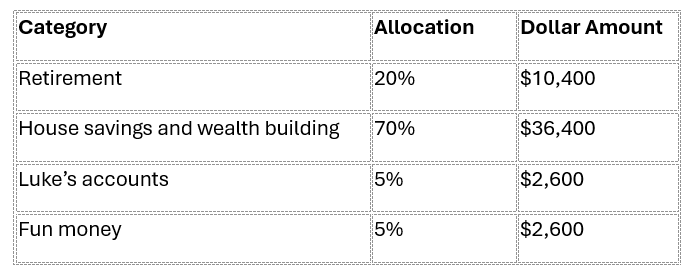
The retirement contribution will be directed to backdoor Roth IRAs. The house and wealth-building allocation will go to their taxable brokerage account. Luke’s allocation will be split evenly between a 529 plan and a brokerage account. The “fun” money bucket will give them permission to enjoy part of their success, perhaps through Disney passes, a trip, or other purchase.
Once the retirement bucket reaches its annual target of $15,000, the amount that would have gone toward retirement will instead be directed toward the house and wealth-building bucket.
The full process is built into a spreadsheet. Once a bonus amount is known, we will enter the number and immediately see the planned allocation. This removes guesswork at the moment when lifestyle inflation is most tempting.
Step 5: Choose the Right Accounts
With each goal, a different type of account may be most appropriate. For Anakin and Padmé, we chose the below accounts for each of their goals.
Goal 1: Buy a Home and Build Wealth
Anakin and Padmé want to purchase a home in Southern California. Buying the home they want will likely require a substantial down payment. For this goal, we will use a taxable brokerage account.
Taxable brokerage accounts are underrated. They do not offer the immediate tax deduction of a traditional 401(k), but they:
Provide flexibility
Have no contribution limits
Have no early-withdrawal penalties
Provide broad investment choices
Have favorable long-term capital-gains treatment
Provide access to funds for a home purchase, business opportunity, early retirement, or other goals
For clients with high income and multiple goals, flexibility can be just as important as tax deferral.
Goal 2: Retire Securely
Anakin does not have access to an employer-sponsored retirement plan, but Padmé has access to a 401(k). They view their financial life jointly, so Padmé’s 401(k) will be a key part of their household retirement strategy.
The plan will be to maximize Padmé’s 401(k) through regular payroll contributions and use bonus income to fund Roth IRAs through the backdoor Roth process.
In higher-income years, their retirement savings capacity may exceed the available retirement-account limits. During those years, the taxable brokerage account will become the overflow vehicle for additional long-term savings.
Goal 3: Set Luke Up for Success
For Luke, we will use both a 529 plan and a taxable brokerage account.
Using both accounts will provide flexibility. The 529 can be used for qualified education expenses, while the brokerage account can be used later for other opportunities like a first home, business venture, wedding, or other major life milestone.
Just as importantly, Anakin and Padmé will retain control over the funds.
Step 6: Determine Asset Allocation
Goal 1: House Savings and Wealth Building
Determining the right asset allocation for a home purchase can be challenging when there is no fixed purchase date.
An overly conservative allocation may mean you miss meaningful growth if the home purchase is delayed. But an overly aggressive allocation could leave the portfolio down significantly at the time funds are needed.
For Anakin and Padmé, I will use a growth-oriented allocation of approximately:
75% globally diversified equities
25% trend following, precious metals, and short-term bonds
Because they will be dollar-cost averaging through monthly contributions and making larger deposits during bonus periods, they can potentially tolerate more equity exposure than someone with a fixed home-purchase date just a few years away. Their timeline will be flexible, and the home goal can be delayed if markets are unfavorable.
That flexibility is valuable, but it does not eliminate risk. The closer they get to a defined purchase date, the more we will likely reduce portfolio volatility and protect the down-payment funds.
Goal 2: Retirement
With a retirement horizon of more than 30 years, an equity-focused portfolio will offer the highest expected long-term return. Risk over the long-term is not volatility but inflation.
Inside the 401(k) and Roth IRAs, we will build a globally diversified portfolio using low-cost funds.
Goal 3: Luke’s Future
Luke’s 529 plan will have an approximate 18- to 22-year time horizon, while the brokerage account may have a 25+ year horizon. Given those long time frames, we will apply similar logic to the retirement portfolio and use a globally diversified equity allocation.
As Luke gets closer to college age, the 529 allocation will become more conservative to reduce the risk of a market downturn immediately before tuition payments are due.

Step 7: Monitor the Plan
Writing a plan like this is not particularly difficult. I’m sure Claude could produce a reasonable outline. The hard part is following through.
To make implementation easier, I will maintain a list of Anakin’s pending sales opportunities. On the third Friday of each month, we will have a brief call to review the status of those deals.
When a deal closes, we will schedule a planning conversation to review the expected bonus, tax withholding, timing, and predetermined allocation of the funds.
Then it becomes a repeatable process:
Monthly contributions will continue automatically once debt is eliminated.
Debt repayment will remain the immediate priority.
Emergency reserves will be maintained.
Bonus dollars will be assigned before they are spent.
The household will stay focused on long-term goals.
The system is not complicated, but a simple system followed consistently can be extraordinarily powerful.
If you are a sales professional with uneven income and want help creating a structure for turning high earnings into long-term wealth, email me at nick@swrpteam.com to see whether we may be a fit to work together.
This material is purely intended to be general and educational in nature, and should not be construed as specifically-tailored investment, financial planning, tax, legal, or other professional advice. Information and data contained herein is as-of the date of publication, and may be subject to change in the future without notice. Any investment performance referenced is purely past performance, which is no guarantee of any future performance. Nothing contained herein should be construed as an offer to sell, a solicitation of an offer to buy, or a recommendation of any security or other financial product or investment strategy. All investment, tax, and financial planning strategies involve risk that you should be prepared to bear. You are highly encouraged to consult with professionals of your choosing before taking any action based on this material.