Testamentary CRAT: The Triple Crown Estate Planning Strategy
Several years ago, I was at an Estate and Tax planning conference, trying to stay awake 😊 when the speaker said, “This next strategy is for all the procrastinators who know they have an estate tax problem, but don’t really want to deal with it right now.” My ears perked up as this describes a lot of the high-net-worth families that I’ve worked with over the years. They care about their kids and grandkids and want to protect them; they care about certain charitable organizations and want to continue supporting them; and, they want their estate to pay as little in tax as legally possible. At the same time, they’ve already done a lot of estate planning and don’t want to spend all of their time worrying about what will happen after they’re gone.
Section 1: The Triple Whammy
The strategy that this Attorney went on to describe is called a Testamentary CRAT, or Charitable Remainder Annuity Trust. The reason this strategy is preferred by procrastinators is because of the definition of the word Testamentary.
Now, the word “Testamentary” (test-uh-MEN-tuh-ree) sounds scary, but it just means the trust starts AFTER you pass away. It gets set up in your will or your Revocable Living Trust, like a gift you planned ahead of time.
The concept here is that the CRAT doesn’t get funded until you die, which means you get an estate tax deduction without having to establish, fund, and administer an irrevocable trust during your lifetime.
At your death, the CRAT gets funded and your heirs receive a stream of income (we can set this up so that it’s a set amount for a set period of time), and at the end of the period, your favorite charity or charities receives whatever is left in the Trust.
Because this strategy combines 3 different concepts into one, it would be helpful if we looked at an example.
In each Section we will lay out who gets what, and then pull it all back together so you can see why this is considered the Triple Crown Strategy.
Section 2: Show Me the Money - Heirs + Charity💰
The Numbers Tell the Story
Let’s call our two lucky beneficiaries Alex and Jordan. Alex is 45 years old, and Jordan is 42.
Both are responsible adults who will receive part of their inheritance via lump sum, and part via a 20-year installment from the new CRAT that gets created when their Mom dies.
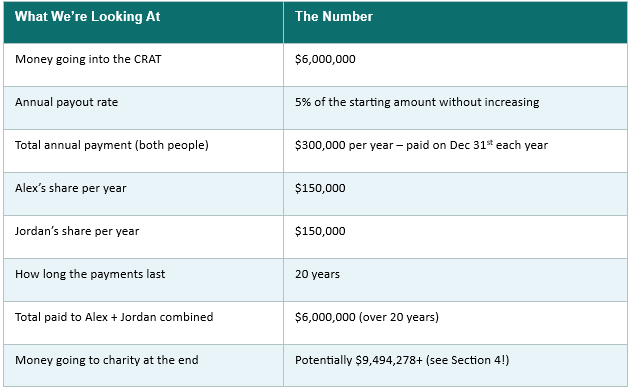
I know what you’re thinking: “Wait, $6M goes IN and $6M comes OUT to the kids, and then ALSO roughly $9.5M goes to charity?! That’s ~$15.5M total from $6,000,000! How?!”
That’s the magic of investing. The trustee doesn’t just sit on the money, it gets invested along the way.
Section 3: The Tax Magic ✨ (Yes, Taxes Can Be Magical)
The Estate Gets a Big Tax Break
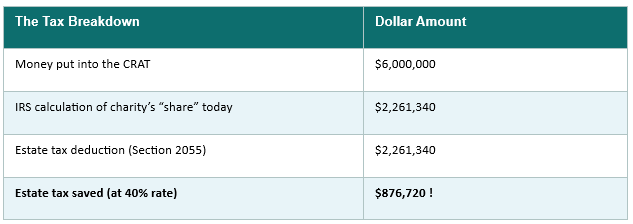
Here’s something cool. When your estate sets up the CRAT, the IRS says: “Hey, part of that money is going to charity someday, so we’ll give you a deduction right now.”
This deduction is called the IRC Section 2055 Charitable Deduction, and the deduction is based on how much the charity will eventually receive, in today’s dollars. There’s a special interest rate the IRS uses to figure this out, called the Section 7520 rate. In our example, we’re using 5.00%.
Using that rate, the IRS calculates the charity’s future money is worth about $2,191,800 today. So the estate gets a $2,191,800 deduction. At a 40% estate tax rate, that saves the estate about $876,729 in taxes.
Let’s make that concrete:
What About Taxes on Alex and Jordan’s Payments?
We mentioned earlier that Alex and Jordan get $150,000 each per year. From that, a common question is: how is that income taxed to them?
CRAT distributions are taxed in layers. Here’s the order from most taxed to least taxed:
Layer 1 — Regular income (like interest or dividends): Taxed like a paycheck, can be up to 37%.
Layer 2 — Long-term investment gains: Taxed at a lower rate, usually 15–20%.
Layer 3 — Tax-free income: If the trust earned any tax-free money, it passes through tax-free. Woohoo!
Layer 4 — Return of original money: This comes out totally tax-free. Double woohoo!
In our example, let’s say each $150,000 payment is roughly 60% regular income and 40% investment gains. After taxes, here’s what Alex and Jordan get to keep per year:
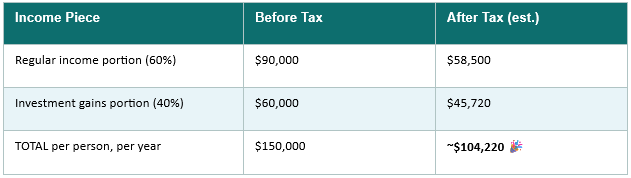
Each person keeps about $104,220 after taxes every year. Over 20 years, that’s over $2,000,000 per person. Not too shabby for money that was just sitting in an estate!
Section 4: The Trust Across 20 Years 📅
How Does the Trust Grow Over Time?
Remember how we said the ‘proverbial cookie jar’ keeps growing? Here’s a look at how the trust balance changes over 20 years, with our assumed 6.5% annual return and $300,000 in annual payouts.
These are estimates. Real results will vary based on markets, fees, and whether the trustee/investment advisor makes good decisions.
What the CRAT Actually Delivers (The Grand Total)
Let’s tally everything up like a very satisfying receipt:
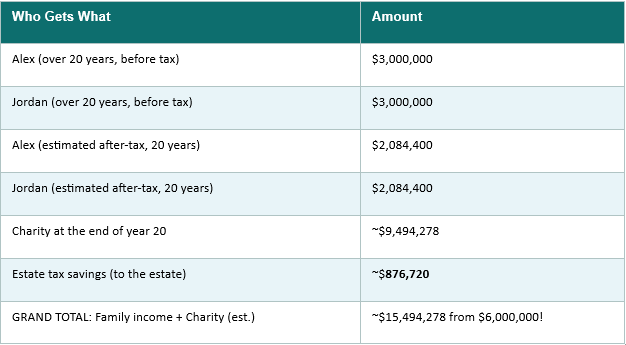
You started with $6,000,000 and the total value delivered is over $15,000,000. In addition, the money your children received was protected from creditors (i.e. a lawsuit or divorce), and your favorite charities (or your Donor Advised Fund) received close to $9.5M at the end.
That’s why we call this the Triple Crown estate planning strategy!
Section 5: CRAT vs. Just Handing Over the Cash
You might be thinking: “Why not just leave $6,000,000 to my kids and skip all this?”
Great question! The testamentary CRAT only makes sense if:
A. You already give money to charitable organizations each year, and
B. You have an estate tax problem, and you want to reduce that tax bill.
From my experience, I cannot imagine a scenario where a parent would leave the entire inheritance their heirs are set to receive via this kind of structure.
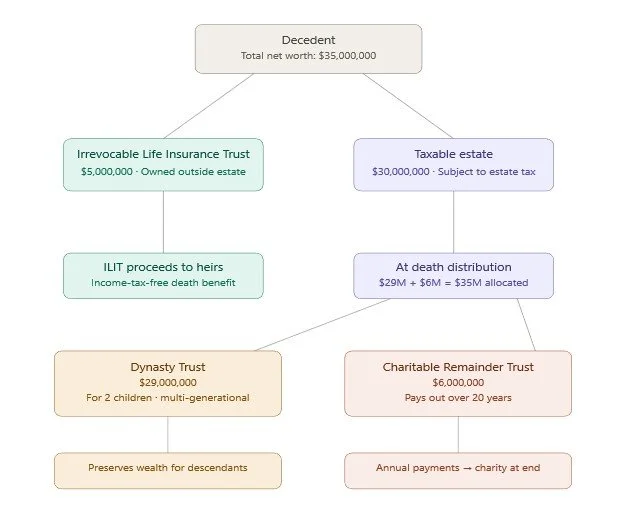
A more typical scenario is where Mom and Dad are worth $35M and plan to leave $6M-$10M via this kind of structure, and the rest via a Dynasty Trust where their heirs have lifetime access to their portion of the money.
At this size estate we typically see a combination of strategies, including an ILIT (which removes assets from the taxable estate), a Dynasty Trust (which keeps assets in the family for generations) and something like a Testamentary CRAT. Here is an example:
Section 6: Important Rules to Know 📋
A Few Things You Can’t Change
The CRAT has some firm rules. Think of them as the Cookie Jar Constitution:
Once it starts, it can’t be undone. The CRAT is irrevocable, which means nobody can change their mind. Choose your beneficiaries wisely!
No topping it off. You can’t add more money to a CRAT after it’s created. What goes in at the start is all there is.
The 5% rate is locked in forever. Alex and Jordan get $150,000 each, every year. This amount stays the same, even if the market crashes or the trust grows hugely. No more, no less.
The 10% rule must be met. At least 10% of the starting value must be “deserved” by the charity.
The charity must be qualified. It must be an IRS-approved nonprofit (Section 501(c)(3)). These include universities, hospitals, community foundations, and established charities.
What if the trust runs out of money before 20 years?
This is called “annuity exhaustion” and it’s the CRAT’s one scary monster under the bed. If the investments do really, really badly AND the 5% is being paid regardless, the jar could empty early.
This is why picking a good trustee and solid investment strategy matters. Don’t let the cookie jar go empty!
Who’s in Charge? The Trustee.
The trustee is the grown-up in the room. They invest the money, make sure Alex and Jordan get their checks on time, file the trust’s tax return every year, and eventually hand the remaining cookies to the charity.
For a $6,000,000 trust, you would want a team that can work together, which will include a CPA, Attorney, Trustee, and Wealth Manager. The Wealth Manager’s job is to invest the money, work with the beneficiaries, and coordinate the team that administers all of this.
Section 7: Who Is This Ideally Suited For?
Great uses for a Testamentary CRAT:
The person who wants their kids to have steady income, not a big pile of cash they might mismanage.
The person with a strong charity in their heart, like a university, hospital, foundation, or a cause they’ve supported for years.
The person with a big taxable estate who wants to reduce estate taxes while still taking care of family.
The person who wants a structured, predictable gift over uncertainty. Just a plan.
The person that wants all of these things but doesn’t want to establish, fund and administer this sort of irrevocable trust right now “i.e. the procrastinator 😊”
Section 8: Ultimate Charitable Beneficiary 🎓
Having presented this many times to wealthy clients over the years, a common question I receive is, “Who should I name as the ultimate charitable beneficiary, and what happens if I want to change those charitable organizations over time?”
I tell these folks that they have several options to consider:
Name a few specific charities – ones that are timeless.
Name a few causes you care about as the organizations themselves may come and go, but instruct your Trustee well on which causes are important to you.
Name your own DAF at Schwab or Fidelity.
Some combination of these approaches.
If you’ve gotten this far, then this strategy is interesting enough that it’s worth further exploration.
Speak with your professional team or send me an email if you want to learn more: rob@swrpteam.com
This material is purely intended to be general and educational in nature, and should not be construed as specifically-tailored investment, financial planning, tax, legal, or other professional advice. Information and data contained herein is as-of the date of publication, and may be subject to change in the future without notice. Any investment performance referenced is purely past performance, which is no guarantee of any future performance. Nothing contained herein should be construed as an offer to sell, a solicitation of an offer to buy, or a recommendation of any security or other financial product or investment strategy. All investment, tax, and financial planning strategies involve risk that you should be prepared to bear. You are highly encouraged to consult with professionals of your choosing before taking any action based on this material.