A 351 Exchange and How You Can Use it to Diversify Your Portfolio
There are a lot of ways to diversify concentrated stock. To name a few:
Long/Short Tax loss harvesting
Exchange Funds
Variable Prepaid Forward
Selling and Paying taxes
Using a CRT
Using a CLT
The common denominator in all these is that they’re either (1) complex or (2) end in you writing a huge check to the IRS.
A 351 exchange is the only simple, pain free solution whereby you can get out of an equity or ETF, without paying taxes and still keep the funds liquid.
What is a 351 Exchange?
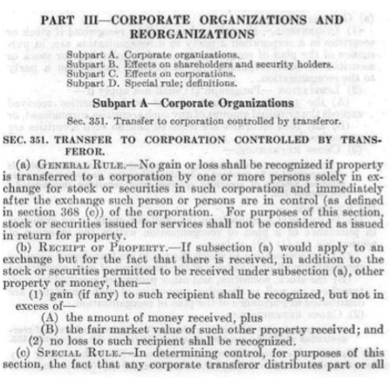
Section 351 of the Internal Revenue Code (established in 1954) allows investors to contribute property to a newly formed corporation in a tax-free exchange.
In 2024, ETF companies such as Alpha Architect and Cambria Investments began administering 351 exchanges with a newer use case: exchanging appreciated stocks and ETFs for shares of a newly-formed ETF.
You can think of it like a 1031 real estate exchange*, but for stocks. In a 351 exchange, you take a handful of stocks and ETFs you currently own and exchange them for a new ETF as long as you follow 2 rules.
*If you are unfamiliar with 1031 Exchanges, Summit wrote an article about them which you can read here: https://www.summitwealthandretirement.com/swrp/1031-exchanges
The Two Rules
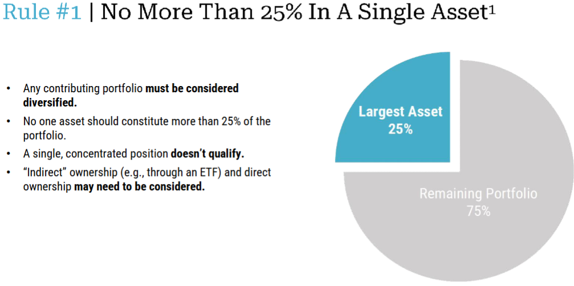
1. No more than 25% in a Single Position
To qualify, no individual holding (ETFs get look through treatment, i.e. SPY is seen as NVDA, GOOGL, AAPL, etc.) can make up more than 25% of your contributed portfolio.
For example, if you want to contribute $250k of Micron, you would need to contribute $750k other holdings.
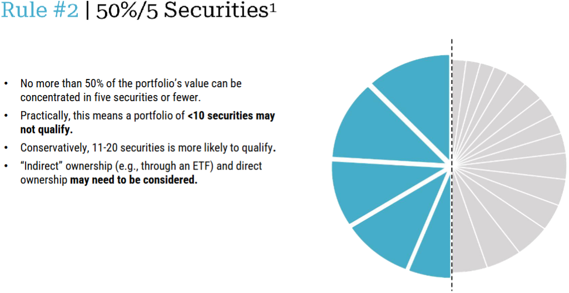
2. No more than 50% in the Top Five
The combined value of your five largest holdings must be less than 50% of the contributed portfolio.
For example, if you wanted to contribute $100k of each Micron, Intel, Exxon, SanDisk, and Broadcom, you would need to also contribute $500k of other holdings.
Real Summit Client Examples
You can find infinite articles and blogs online about 351 exchanges. The issue with them is that most authors have not actually completed the process they’re describing.
At Summit, we’ve helped 10+ of our clients diversify through a 351 exchange. Below are some real examples, with names changed for privacy.
Client 1: Bruce Wayne
Bruce became a client in 2023 and had a portfolio full of large US stocks.
On the brink of retirement, Bruce wanted to diversify some of his big winners. But, as a high earner in California, the effective tax rate would have been around 40%.
A 351 exchange was the perfect solution as it allowed him to maintain liquidity for retirement, diversify his portfolio, and not incur a tax liability.
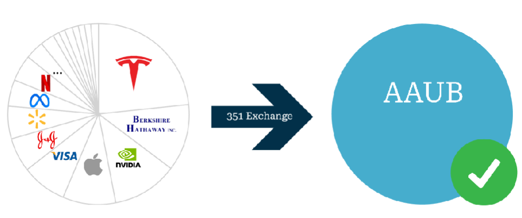
We used a 351 exchange to diversify Bruce’s massive Tesla position + a handful of other big winners (NVIDIA, Exxon, etc) into an S&P 500 ETF (AAUS – Alpha Architects first S&P 500 351 Exchange). Doing so avoided realizing over $500k in capital gains.
Bruce’s portfolio was still overweight large US equities, so we participated in the Cambria Global Weight 351 exchange to increase his international exposure again without paying any taxes.
Client 2: Barry Allen
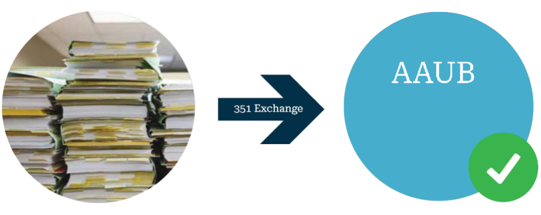
Through a combination of inherited and legacy holdings, Barry’s portfolio had over 100 positions, some with massive gains and others at a loss.
Because he held so many positions, Barry did not know what he owned. He instead wanted a simple, balanced portfolio of global stocks, bonds and alternatives.
First, we sold all the positions realizing a substantial loss (which can be used to offset future capital gains, should funds be needed). This still left over 50 positions with large, unrealized gains.
Using a 351 exchange, we converted these 50 positions into one S&P 500 ETF. Had we instead sold the positions, it would have created well over $100k in capital gains.
Barry now has a simplified balanced portfolio that he understands and feels comfortable with.
Client 3: Helen Parr
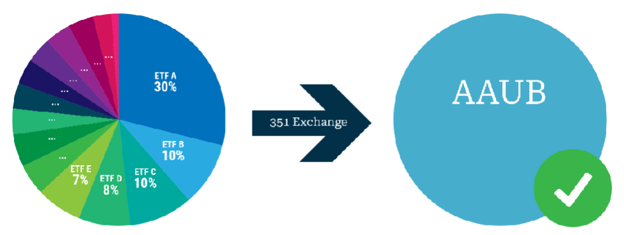
When her father passed, Helen inherited a dozen or so JP Morgan, high cost ETFs.
By the time we took over her account, the gain on the position (even after it was stepped up) did not justify selling and creating the tax bill.
A 351 Exchange served as the perfect solution as it allowed us to do 3 things:
(1) Simplify 12 positions into 1
(2) Lower the fees the client pays
(3) Not pay any taxes
We participated in the AAUA ETF (Alpha Architect US Equity 3 ETF) for Helen and exchanged her 12 positions into one low cost S&P 500 ETF.
Why Now?
If you have Intel or Micron stock, odds are you have patiently waited decades for this generational run. Intel is up ~500% and Micro ~700% over the past year.
To me, it’s a no brainer to take some chips off the table and diversify into an S&P 500 or Global Equity ETF while paying no taxes.
How to Take Action
As an independent RIA, we have a relationship with two investment managers, Alpha Architect ($20B AUM) and Cambria Investments ($3.8B AUM), who we use to participate in 351 exchanges.
While 351 exchanges have been around for decades, exchanges for stocks are relatively new. So, most wirehouses don’t yet offer them to clients. We, as an Independent RIA, can offer them to clients because:
Wirehouses often only allocate to their internal funds (i.e. JP Morgan uses JP Morgan ETFs).
We’re not bureaucratic, so unlike wirehouses we are not slow to add new solutions that help clients.
When you become a comprehensive wealth management client, we can hold your hand though the 351 exchange process.
Actual Timeline for Participation
Using the Alpha Architect 351 Exchange (AAUB) as an example:
2 weeks before launch: Portfolio contributions to be finalized
1 week before launch: Tax lot submissions finalized
2 days before launch: Positions to be contributed will leave your Schwab account and go to the funds custodian (U.S. Bank)
Launch Day: Shares of AAUB will be journalled back into your Schwab account
1 week post launch: As there is carryover basis, the cost basis information will be sent to Schwab
Common Q&As:
Is there a 1x cost to doing a 351 exchange?
No, the only cost is paying the ongoing expense ratio of the new ETF. Alpha Architect has all of their 351 exchanges at 0.0945%, which is less than SPY.
What is something I won’t like about the process?
For 2 days, the positions will leave your Schwab account. If you look at your Schwab account daily, it can feel scary (although there is nothing to worry about) to see it dramatically lower.
What happens to the cost basis?
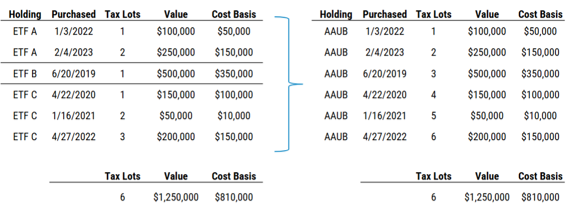
The cost basis is carried over, as is the same in a 1031 real estate exchange.
What if all my net worth is in a single stock?
To participate in a 351 exchange, you would need to sell some of the stock to free up capital so you do not violate the 25 & 50% rules.
Is there legal backing to this?
Whenever a new tax strategy comes out, there are sure to be the naysayers who doubt its validity. As mentioned earlier, a 351 exchange has been around for decades, and investment companies (such as Dimensional funds – a $1M asset manager) have been doing them in private for years. Alpha Architect also gets a third party tax opinion done for each separate 351 exchange it offers (and we have all them on file).
What happens to the tax lots?
See image below.
351 exchanges may seem complex, but they are a proven tax strategy that we are experienced in helping clients with. For any questions on this, email me: nick@swrpteam.com
This material is purely intended to be general and educational in nature, and should not be construed as specifically-tailored investment, financial planning, tax, legal, or other professional advice. Information and data contained herein is as-of the date of publication, and may be subject to change in the future without notice. Any investment performance referenced is purely past performance, which is no guarantee of any future performance. Nothing contained herein should be construed as an offer to sell, a solicitation of an offer to buy, or a recommendation of any security or other financial product or investment strategy. All investment, tax, and financial planning strategies involve risk that you should be prepared to bear. You are highly encouraged to consult with professionals of your choosing before taking any action based on this material.