

Bypass Trust Funding Explained: What to Do After a Spouse Dies
I’ve spent the past 20+ years working with financially successful families, and one of the things that almost all of them have in common is an irrevocable trust.
To be clear: for the sole purpose of avoiding probate, 100% of the families I’ve worked with have had a revocable living trust (RLT). But, an irrevocable trust is quite different.
Most people have heard of a simple RLT, but according to former accountant and tax legend Bob Keebler, there are 29 other types of trusts! And, since oftentimes the same trust will have multiple names (i.e. a Bypass trust is also known as a Family trust), I am sure you can find articles that count more than 30 kinds.
In our last Blog post, we covered questions like, “Do I really have to fund my bypass trust at 1st death?” and “What do you mean our Revocable Living Trust says to create 2 trusts when my spouse dies?”
For today we are going to skip those, and refer you to this previous article if you haven’t already seen it.
Let’s dive into funding your Bypass Trust, and the pros and cons of selecting which assets to fund your it with.
You may be wondering, “Isn’t this a decision that the Attorney who handles our estate will make for us?” My experience is that the answer to that question is firmly, “NO!”
“What about the CPA, can’t they make that decision?”
Same answer (No!) but for different reasons.
One of the things we often speak with our clients Attorneys and CPAs about is what we call the Wealth Triangle:
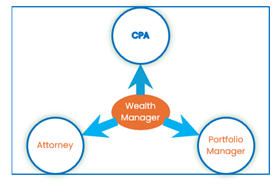
When you are wealthy and your life has the complexity that comes with wealth, the financial decisions you make have legal (estate), tax, and investment ramifications.
Most attorneys (not all, we know some great ones that started on the tax side and then became attorneys) address things purely from a legal perspective. Most CPAs will address things purely from a tax perspective. And, don’t get me started on most Investment Advisors…
So, who brings a holistic perspective to these decisions?
If you are not working with a Wealth Manager that specializes in this area, the answer is YOU!
Now back to the funding itself, here’s a typical scenario/fact pattern:
Let’s assume a couple is worth $10M (all community property and no retirement accounts, just to keep things simple).
Their assets consist of a Primary Residence worth $3M, a Vacation Home worth $2M, and a Brokerage Account worth $5M.
Dad dies and Mom is told she has to fund a Bypass Trust, per the terms of their formerly Revocable (now Irrevocable) Living Trust.
$5M will go into the Bypass Trust and $5M will remain in the Survivor’s Trust.
The assets that go into the Bypass Trust are no longer a part of Mom’s estate. She does have the legal right to receive income from the trust (every trust is different), but can only touch the principal for Health, Education, Maintenance, and Support.
At her death, the assets in the Bypass Trust go to their kids. Even if she remarries and her second marriage lasts another 30 years, she cannot name her new spouse as the beneficiary of the Bypass Trust.
Assets held in the Survivor’s Trust will receive a full step up in basis when Mom dies. Assets held in the Bypass Trust will not.
Finally, the $250K/$500K capital gain allowance on the sale of a primary residence will continue to apply to the home if held in the Survivor’s Trust, but not if it’s held in the Bypass Trust.
As the Wealth Manager, we would review the investment account statements and meet with the family to find out what the long-terms plans are for both residences.
Let’s assume that the $5M brokerage account is $3M in stocks and $2M in bonds. Let’s also assume that Mom plans to downsize the Primary Residence, but wants to keep the Vacation Home forever, as she sees it as a place where her kids and grandkids will gather during vacations and summer breaks for several generations.

Given this fact pattern, it might make sense to place the $2M Vacation Home and $2M worth of bonds into the Bypass Trust. It might also make sense to put a $1M promissory note in there (from the Survivor’s Trust to the Bypass Trust), funded annually with interest payments using the applicable federal rate. The bonds produce income, which Mom receives as per the terms of the Trust. The lost step up in basis on the Vacation Home is moot because it never gets sold.
In the Survivor’s Trust, Mom sells the Primary Residence and benefits from the capital gain exclusion. She uses the proceeds to buy a smaller house, and uses the rest to pay off the promissory note (essentially transferring $ back into the Bypass Trust). The stocks are held during her lifetime and receive a full step up in basis at her death.
Finally, the assets in the Bypass Trust offer everyone a degree of asset protection. Mom is protected from potentially losing those assets in a second marriage that results in divorce, or a car accident that results in a lawsuit against her. The kids are protected from a loss of inheritance as Mom never had the right to re-direct those assets at her death.
The idea of splitting one’s estate at first death often leads to the question: “Why does this all have to be so complicated?” But, wealth and complexity is where Wealth Managers shine, because the intersection of estate planning, tax planning, and investment management are wealth real wealth managers add the most value.
If you or someone you love is seeking this kind of advice around wealth and complexity, please send me an email at rob@swrpteam.com or visit us at www.summitwealthandretirement.com
Finally, our specialty is helping successful families navigate wealth and all the complexity that comes with it. We want to continue to write about the topics that are most important and interesting to readers like you – so if you have questions or blog article ideas, please reach out to us and let me know: rob@swrpteam.com
Author: Robert Cucchiaro, CFP®
This material is purely intended to be general and educational in nature, and should not be construed as specifically-tailored investment, financial planning, tax, legal, or other professional advice. Information and data contained herein is as-of the date of publication, and may be subject to change in the future without notice. Any investment performance referenced is purely past performance, which is no guarantee of any future performance. Nothing contained herein should be construed as an offer to sell, a solicitation of an offer to buy, or a recommendation of any security or other financial product or investment strategy. All investment, tax, and financial planning strategies involve risk that you should be prepared to bear. You are highly encouraged to consult with professionals of your choosing before taking any action based on this material.